
"Shanghai: A Haipai City Between Shikumen Houses and Skyscrapers"
By PandaTrip Editorial · 7 min read · Verified 2026-09-06
Verified 2026-09-06

Among China's great cities, Shanghai is a "youngster" — formally opened as a port less than two hundred years ago, it is 2,800 years younger than Xi'an. Yet this youngster had already become "the greatest metropolis of the Far East" by the 1930s, and today it is China's economic center and its gateway to globalization. To understand Shanghai, what matters is not depth of time but density: on a palm-sized stretch of land are layered the foundations of a Jiangnan water town, the colonial memories of the concession era, the civic society inside the shikumen (stone-gate terrace houses), and the skyscrapers of global capital.
From a Small County of Songjiang Prefecture to the "Ten-Mile Foreign Settlement"
The origin of the Shanghai story is often told wrong: it was never a "small fishing village." In the Tang and Song dynasties, the town of Shanghai was already a trading port on the Wusong River (today's Suzhou Creek); the Yuan dynasty established Shanghai County; under the Ming and Qing it belonged to Songjiang Prefecture, and its thriving cotton textile industry "clothed the empire" — the wealth of Jiangnan was its base tone. The real turning point was the port's opening in 1843: after the Opium War, the Treaty of Nanking was signed, Shanghai became one of the five treaty ports, and Britain, the United States, and France set up concessions one after another.
Over the following century, Shanghai went through the most dramatic transformation in Chinese urban history. Foreign banks and trading houses lined the Huangpu River in a row; from 1854 the concessions mixed Chinese and foreign residents, and the population swelled from a few hundred thousand to more than three million on the eve of the War of Resistance Against Japan; Nanjing Road became "China's No. 1 commercial street"; the French air of Avenue Joffre (today's Middle Huaihai Road), the horse races at the racecourse, and the jazz at the Paramount ballroom composed the so-called "ten-mile foreign settlement." The duality of that era remains the key to understanding Shanghai today: it was both a product of national humiliation and the soil where modern urban planning, finance, publishing, film, and education first took root in China.
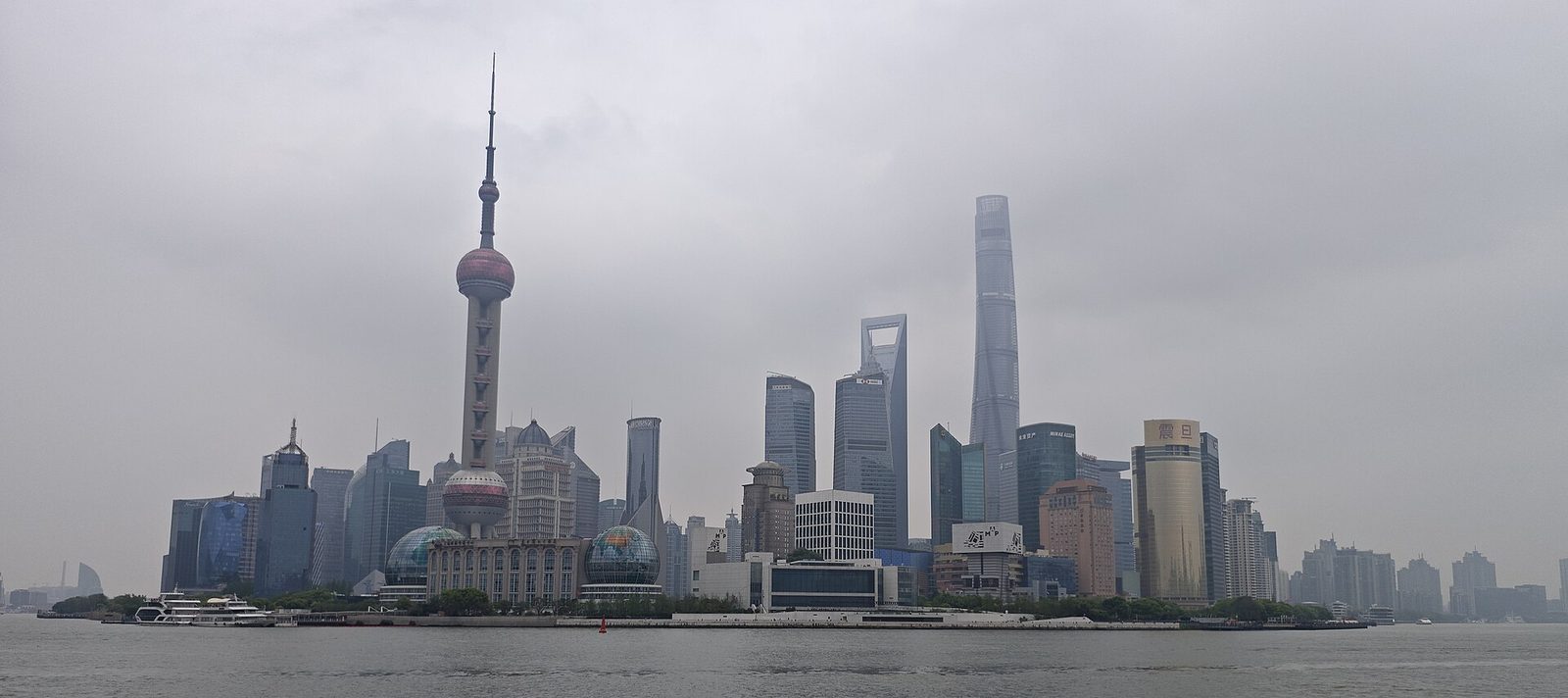
After 1949, Shanghai continued to play its role as an industrial and fiscal powerhouse; in 1990, the development and opening of Pudong was launched, and on the rice paddies of Lujiazui rose the Oriental Pearl Tower (1994) and, later, China's tallest building, the Shanghai Tower (632 meters). Today Shanghai is China's No. 1 city by GDP and an international financial center, as well as the most internationalized lifestyle stage in mainland China — its cafés rank among the most numerous of any city in the world, and the twice-yearly China International Import Expo (CIIE) and countless global product launches land here.
Urban Form: One River, One Creek, Three Layers of Shanghai
Shanghai's spatial logic is remarkably clear and can be read in three layers:
The Bund–Lujiazui axis is Shanghai's cover page. On the west bank of the Huangpu River, the Bund's 52 historic buildings of every style form a "world architecture fair"; on the east bank, Lujiazui's "three-piece set" (the Jin Mao Tower, the Shanghai World Financial Center, and the Shanghai Tower) faces the Oriental Pearl Tower across the water — a financial center of a hundred years ago and a financial center built within thirty years recognizing each other across the river, a city dialogue rarely seen anywhere in the world.
The former concession districts are Shanghai's body. In streets shaded by plane trees, garden villas, new-style lane houses, and apartment blocks weave a dense urban fabric; the "plane-tree district" of Wukang Road, Anfu Road, and West Fuxing Road is the current holy land of the city walk (City Walk) — the pleasure here lies not in any single spot but in the scale and detail of the streets themselves.
The shikumen longtang alleys are Shanghai's cells. This building type, fusing the courtyard layout of Jiangnan folk houses with the features of Western terraced housing, was a high-density solution forced out by soaring land prices after the port's opening, and the container of Shanghai's civic society — tingzijian ("garret") literature, longtang life, and the shrewdness of "holding a ceremony inside a snail's shell" all grew out of the shikumen. Xintiandi turned shikumen into a commercial quarter, Tianzifang into an arts-and-crafts lane, while many more authentic shikumen still run in everyday use, waiting for the next chapter of urban renewal.
Haipai Culture: A Civic Aesthetic Blended from China and the West
The term "Haipai" was first used by Beijing critics to tease Shanghai painters (as the counterpart of the "Jingpai" Beijing school); it later became the umbrella term for the city's culture. Its core is fusion and pragmatism: judge people by ability rather than origin, respect rules and contracts, and take a near-instinctive interest in the "new."
A few slices: Benbang cuisine (Shanghai's local cooking) is Jiangnan in rich oil and dark sauce — hongshaorou (red-braised pork) must be "glossy, sweet, and melting," and cao tou quanzi (pork intestines with alfalfa), yan du xian (salted-and-fresh pork soup with bamboo shoots), and paigu niangao (pork chops with rice cakes) are its signature dishes; the lao kele tradition of "Shanghainese eating Western food" (borscht, fried pork cutlet with Worcestershire-style sauce) is equally part of the Benbang memory. The Shanghai dialect (Huyu), representative of the Taihu group of the Wu language, is soft yet edged — nong (you), yi (he/she), and baixiang (to play) remain the passport of the longtang. Café culture, meanwhile, has completed its transformation from import to urban infrastructure — Shanghai leads the world in café density, counted in the tens of thousands, and the local pairing of "coffee plus scallion-oil pancake" feels perfectly natural.
In the arts, Shanghai is the birthplace of Chinese cinema, the center of modern publishing, and a market shared by jazz and Yue opera (the Shaoxing theater that came to try its luck on the Shanghai Bund). This appetite that "can hold everything" is precisely the essence of Haipai.
Shanghai Today: China's Most International Everyday
Today Shanghai has about 25 million permanent residents and leads China in actually utilized foreign investment and in the number of regional headquarters of multinational corporations. For travelers, its friendliest feature is that "internationalization" lives in the details: widespread English signage, accessibility facilities, international schools and hospitals, and a complete spectrum of global dining — while retaining the strongest texture of local life in all of China: dawn breakfast stalls (the "Four Kings" of breakfast: dabing flatbread, youtiao fried dough sticks, zifan sticky-rice rolls, and doujiang soy milk), weekend street-side wet markets, and the running paths along Suzhou Creek.
Disneyland (opened in 2016) sits on the eastern outskirts; the Ming-dynasty gardens of Yu Garden and the snacks of the City God Temple sit in the Old City; and the museum cluster of the West Bund — Tank Shanghai and the Long Museum — represents its contemporary side. Shanghai can deliver on any travel preference.
How to Feel the City
At dawn, walk the Bund from north to south and watch the morning exercisers share a frame with Lujiazui across the river; by day, wander the plane-tree district aimlessly and duck into a corner café when tired; at dusk, go to Yu Garden and the Old City, toggling between a Ming-dynasty garden and internet-famous xiaolongbao (soup dumplings); after dark, return to the Bund for the illuminations, or ascend Raffles City on the North Bund or a Pudong high-rise to take in both faces of Shanghai in one view. To touch the real texture of the shikumen, skip the main street of Xintiandi and go to Bugaoli (the Cité Bourgogne) or a longtang still in daily use to see the street life hanging on the laundry poles. Finally, save one breakfast for a zifantuan (sticky-rice ball) at the mouth of a longtang — that is the true power-on button of a Shanghai day.
Frequently asked questions
When is the best time to visit Shanghai?
March–May and October–November are the most comfortable. Summers are hot and humid (the plum-rain season from June to early July is muggy and rainy), and winters are damp and cold. The Christmas season at year's end and the Yu Garden Lantern Festival before Chinese New Year are the highlights of a winter visit.
Where should I stay on a first visit to Shanghai?
The People's Square–East Nanjing Road area is central (a hub of Metro Lines 1/2/8, within walking distance of the Bund); with a generous budget, stay near the Bund or Xintiandi; for a taste of plane-tree-district life, choose the Hengshan Road–Middle Fuxing Road area. Shanghai's Metro is extremely well developed — staying next to a Metro station matters more than staying next to a sight.