
Taking a Ride in China: The Complete Guide to DiDi's International App, AMAP Global English Ride-Hailing, and Street Taxis
By PandaTrip Editorial · 4 min read · Verified 2026-09-06
Verified 2026-09-06

Taxis used to be the hardest part of China for arriving travelers: drivers who didn't know the way, no foreign cards, no shared language. Ride-hailing has done away with most of those problems — the destination goes straight to GPS, the fare is settled online, and the whole trip leaves a record. Here are the main ways to get a ride in China, in recommended order.
First choice: DiDi (international version)
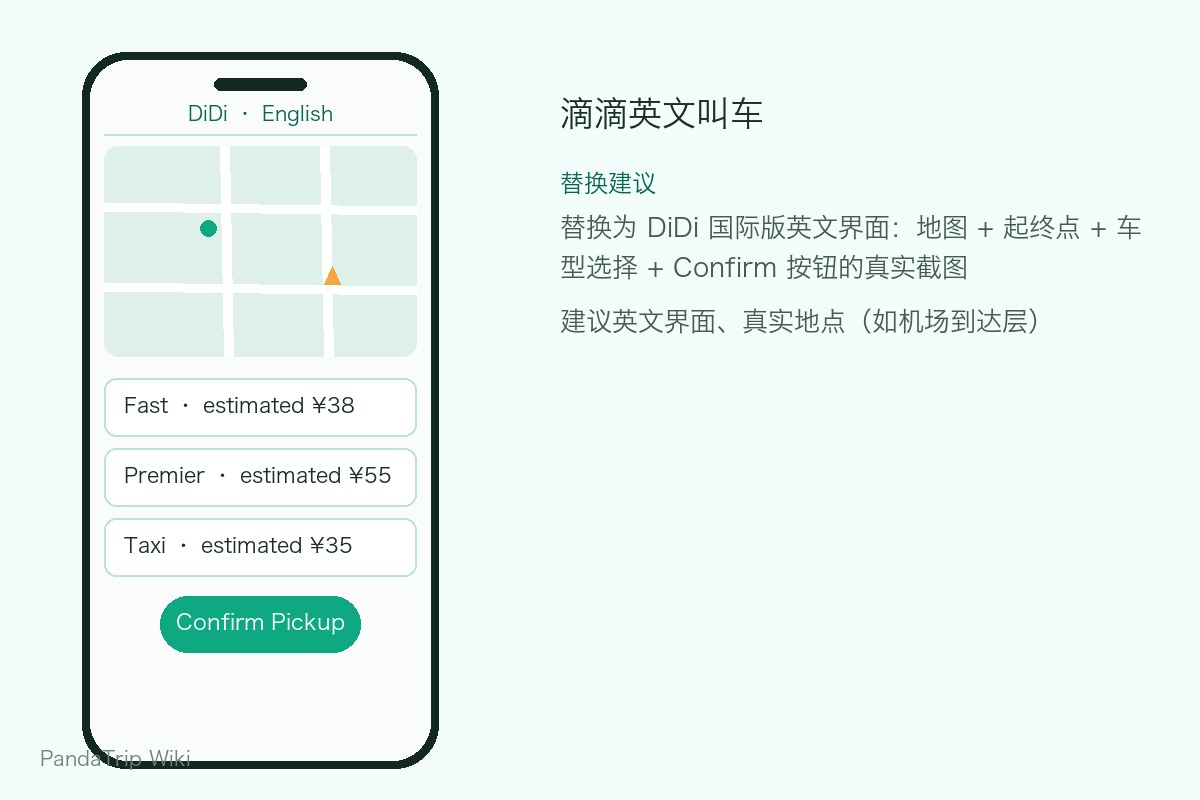
DiDi occupies in China the position Uber holds in Europe and North America — an overwhelming market share, response times of one to two minutes in first-tier cities, and the most complete support for international visitors:
Sign-up: Search for "DiDi" on the App Store / Google Play (note: it's different from the Chinese-language app 滴滴出行), register with your home-country mobile number, and complete identity verification with your passport.
English interface: After signing up you can switch to English; origin and destination accept English input, and the system matches places automatically.
Payment: In Sidebar → Wallet → Payment methods, link an international credit card (Visa/Mastercard, etc.); the fare is charged automatically at the end of the trip. You can also hail a ride directly inside Alipay's 出行 (Transport) section, which runs on Alipay's foreign-card channel. It's worth setting up both payment paths — if one fails, switch to the other.
Vehicle class: The default "Express" (快车) is all you need. Price reference: about 30—45 yuan for 10 km in a first-tier city, and 60—150 yuan from the airport to downtown depending on distance. "Carpool" (拼车) involves coordinating routes with strangers — the communication overhead is high, and it isn't recommended.
Backup: AMAP Global English ride-hailing
AMAP Global, the English-language map launched by Amap in January 2025, has ride-hailing built in: enter your destination in English and book directly, drawing on capacity from multiple ride-hailing platforms. Pick either DiDi or AMAP Global and keep the other as a backup — in the hours when DiDi has no cars available, the aggregator often still does.
Traditional taxis: still a workable option
Street-hailed taxis still exist, and airports and train stations have official taxi queues. Key points:
- Confirm the meter: Watch the driver start the meter as you board. The flag fall is 13 yuan for 3 km in Beijing and 14 yuan for 3 km in Shanghai, then about 2.3—2.7 yuan per km, with a late-night surcharge.
- Payment: Most taxis now display QR payment codes (WeChat Pay and Alipay both work through the foreign-card channel); a small number take cash only. Confirm you can pay by scan before getting in, or just have cash ready.
- Refusals and touts: Drivers refusing fares is fairly common at rush hour and in the rain; never take a car from touts near train stations calling out prices — go to the official queue.
- Receipts: Say "fapiao" (发票, receipt) before you get out and the driver will print one; keep it safe if you need it for reimbursement.
Communicating with the driver
- Give the last digits of your phone number: Ride-hailing drivers confirm who you are by the last digits of your phone number — just say them or show the app screen.
- Carry a Chinese address card: Hotel front desks can provide a card printed with the hotel's Chinese name, address, and phone number; hand it to the driver when you get in. A screenshot on your phone of your destination's Chinese name works just as well.
- Use in-app translation: DiDi's built-in chat automatically translates English into Chinese for the driver, and vice versa.
Safety and disputes
China's overall safety record for taxis and ride-hailing is good, but cover the basics: check the license plate before boarding, share your trip with a companion, and at night prefer ride-hailing, which leaves a trip record. If you leave something in a ride-hailing car, you can contact the driver directly in the app; with a taxi, use the car number and company phone printed on the receipt.
For obvious detours or overcharging, a complaint filed in the ride-hailing app usually gets the difference refunded; with a taxi, note the car number and call the complaint number printed on the body or the 12328 transportation service supervision hotline.
When not to take a car
In city centers during the morning and evening peaks (7:30—9:30, 17:30—19:30), traffic plus surge pricing means the metro is usually twice as fast over the same distance. If you land at the airport in the small hours after the metro has stopped running, pre-booking an airport transfer in the app is more reliable than queuing on the spot.
Frequently asked questions
I don't speak Chinese. Can I still communicate with the driver on DiDi?
Yes. The DiDi app has built-in translation for driver-passenger messages: common phrases (I'm at the airport arrivals level; please open the trunk) can be sent with one tap and are automatically translated into Chinese for the driver. Once you're in the car you barely need to speak — navigation takes care of the route.
I linked an international credit card, so why did the payment still fail?
In a small number of cases DiDi routes the charge through WeChat Pay or Alipay, where international cards don't work. The safest approach is to link a card in DiDi and, in addition, add a foreign card in Alipay as a backup payment channel — or take a taxi and pay cash.