
Xi'an: Capital of Thirteen Dynasties and the “Living Chang'an”
By PandaTrip Editorial · 7 min read · Verified 2026-09-06
Verified 2026-09-06
If only one city could stand for the ancient history of "China," most historians would choose Xi'an. The Zhou raised their rites and music here, the Qin unified the realm here, and the Han and Tang met the world here with openness and confidence — the Silk Road set out from these city gates, and Japanese envoys and foreign students gathered here in crowds. Today the city is called "Xi'an," but in poetry and in the memory of the East Asian cultural sphere it carries a louder name: Chang'an.
Capital of Thirteen Dynasties: Home Turf for the Second Half of Chinese History
"Thirteen dynasties made their capital in Xi'an" is the standard scholarly count — thirteen regimes including the Western Zhou, Qin, Western Han, Sui, and Tang ruled from here across more than a thousand years. A few milestones are worth remembering.
The Western Zhou built Fengjing and Haojing on the two banks of the Feng River southwest of today's Xi'an (from around 1046 BC), and the framework of China's "civilization of rites and music" took shape here. The Qin capital Xianyang lay to the northwest of today's Xi'an, and the Mausoleum of the First Qin Emperor and the Terracotta Army lie within today's Lintong District — in March 1974, farmers in Lintong digging a well unearthed a ceramic head, and the underground legion was revealed. In 1987, the mausoleum and its pits joined China's first batch of World Heritage Sites. Every warrior has a distinct face, the workshops ran a clear assembly-line division of labor, and the rust-proofing on the bronze weapons remains unexplained — the degree of Qin "standardized production" is enough to overturn everything you imagined about ancient industry.
The Western Han (from 202 BC) made Chang'an its capital; Zhang Qian set out from here to open up the Western Regions, and from then on the Silk Road linked Europe and Asia. Chang'an under the Tang (from 618) was the largest city of the medieval world: 84 square kilometers, 108 chessboard-grid walled wards, and a resident population of one million — Persian merchants, Japanese envoys to the Tang, students from Silla, and Nestorian monks all lived here, a cultural melting pot almost unheard of in the ancient world.
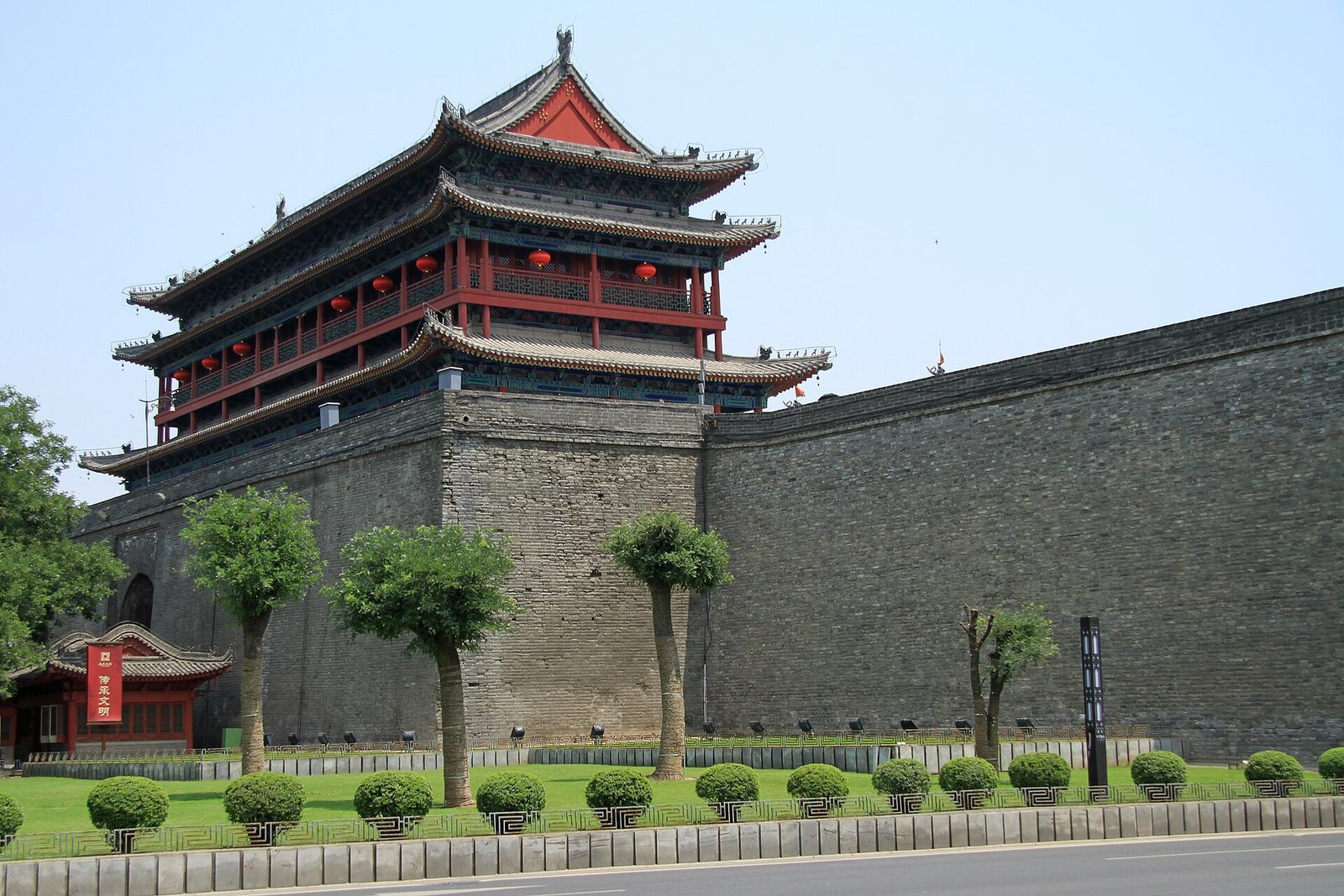
After the Tang, the political center shifted east and south and Xi'an fell quiet for nearly a thousand years, but its identity remained: in the Ming dynasty it was renamed Xi'an Prefecture (1369), the name "Xi'an" carrying the sense of "pacifying the northwest." The surviving Ming city wall was built during the Hongwu reign of the Ming (1370–1378), clad in brick and enlarged on the foundations of the Tang palace city; at 13.74 kilometers around, it is the largest and best-preserved ancient city wall in China.
Urban Form: An Ancient Capital You Can Measure
Xi'an's urban layout is itself an artifact. Inside the Ming wall, the old city keeps its chessboard grid to this day: the Bell Tower at the center, four great avenues running straight to the gates, a street network perfectly horizontal and vertical — looking down at the old town from the wall, you see the Ming plan exactly as it was drawn. At the south end of the Central Axis stands the Giant Wild Goose Pagoda (built in 652 under Xuanzang's supervision to house the scriptures he brought back); at the north end lies the Bell and Drum Tower shopping district, nicknamed by netizens "Xi'an's living room." This invisible north–south axis strings together the city's memory from the Tang to the Ming.
Geographically, Xi'an sits in the middle of the Guanzhong Plain, backed by the Qinling Mountains to the south and facing the Wei River to the north; the pattern of "eight rivers winding around Chang'an" created the agricultural base for capital-building. From a downtown high-rise today, the main ridge of the Qinling is clearly visible to the south — the mountain-and-water framework of this city has not changed in two thousand years.
Cultural Bedrock: The Forest of Steles, the Muslim Quarter, and Everyday Chang'an
Xi'an's cultural density soaks into the everyday. The Forest of Steles (first established in 1090 in the Northern Song) holds thousands of stone tablets spanning the Han dynasty to the modern era; masterpieces by Yan Zhenqing, Liu Gongquan, and Huaisu survive carved in stone, and the Kaicheng Stone Classics — the complete Confucian canon — form a library made of rock. Ci'en Temple, where the Giant Wild Goose Pagoda stands, is the founding temple of the Consciousness-Only school; to the southwest, the Xi'an Museum beneath the Small Wild Goose Pagoda preserves a thousand-year cross-section of Chang'an.
The Muslim Quarter in the northwest corner of the old city (around Huajue Lane and Beiyuanmen) is the heart of the city's flavors and street life: since the Ming and Qing dynasties, the Hui community has grown up around the Great Mosque on Huajue Lane (founded in the Tang; the surviving buildings are mostly Ming and Qing), and today the lanes are packed with shops selling paomo, roujiamo, kebabs, and persimmon cakes. Learn to tell the "tourist Muslim Street" from the alleys locals actually frequent — Sajinqiao and Dapiyuan are closer to the real thing than the main drag.
The character of Shaanxi people is as weighty and direct as the land's history. Qinqiang opera is one of China's oldest opera forms; its roaring, far-carrying power inspired the saying "Across 800 li of the Qin plains the dust flies, as thirty million Shaanxi folk roar Qinqiang together."
Local Signature: The Confidence of the Carbohydrate Capital
The soul of Xi'an's food is wheat and mutton: yangrou paomo (tearing the bread yourself is part of the ritual — the smaller the pieces, the better it soaks up the broth), biangbiang noodles (a character with more than fifty strokes, noodles as wide as a trouser belt), roujiamo (lazhi-braised pork in a bajimo flatbread — Xi'an locals shake their heads at the "Chinese burger" label, since which came first is an open question), the "Three Qin set" of liangpi cold noodles with an Ice Peak soda, hulutou stew, and zenggao sticky rice cake. The food here is solid in calories and loud in flavor, true to the city's historical temperament: never delicate or tricksy, but with deep confidence.
Xi'an Today: Archaeology by Day, High Tang by Night
Today Xi'an is the largest city in northwest China, with around 13 million permanent residents; its scientific and educational strength ranks among the nation's best (a dense cluster of universities and defense-industry institutes), and it is a major Chinese hub for aerospace. The city's most distinctive daily reality is archaeology woven into life: metro construction unearthing ancient tombs is routine (which is why Xi'an's metro took so extraordinarily long to build), and relic displays inside metro stations and heritage parks beneath school playgrounds turn "living atop history" from a figure of speech into literal description.
As a destination, Xi'an has pulled off a stunning reinvention in the past decade: the Tang Dynasty Ever-bright City (Datang Everbright City) turns the fantasy of the High Tang into an immersive night scene, where the tumbler lady performer and the "Shengtang Mystery Box" became viral phenomena; the city-wall lantern festival, Tang Paradise, and the live-action show "The Song of Everlasting Sorrow" together build the narrative of a "Chang'an renaissance." Some criticize it as "influencer-ified," but seen another way, a city that tells its own history this vividly is rare anywhere in the world.
How to Feel the City
In the early morning, get onto the city wall and rent a bike to ride the full 13.74-kilometer loop (about 1.5–2 hours), letting the ache in your legs measure the scale of this fortress; at noon, dive into a back alley of the Muslim Quarter for a bowl of paomo, tearing the bread yourself; in the afternoon, watch a calligraphy lesson unfold live at the Forest of Steles, or fill in the Zhou-Qin-Han-Tang sequence of artifacts at the Shaanxi History Museum (remember to reserve ahead); at dusk, stand beneath the Giant Wild Goose Pagoda by the statue of Xuanzang and wait for the musical fountains of the north square and the lights of the Ever-bright City to come on. With extra time, the Terracotta Army and Huaqing Pool to the east, and the valleys of the Qinling to the south, each deserve a full day.
One last reminder: most of Xi'an's core experiences demand reservations and an early start — the Shaanxi History Museum, the Terracotta Army, and the city-wall lantern festival are no exceptions. Two thousand years have accumulated too many spectators for this city; avoiding peak times is the only secret (for reservation details, see our "Attraction Tickets and Reservations in China" guide).
Frequently asked questions
When is the best time to visit Xi'an?
March–May and September–November are best. Summers are hot; winters are dry and cold but deliver snowscapes (the wall and the Giant Wild Goose Pagoda look most ancient under snow). During Chinese New Year, the lantern festival at the Tang Dynasty Ever-bright City (Datang Everbright City) is packed shoulder to shoulder — the experience and the crowds both peak at once.
What is the best way to visit the Terracotta Army?
The site is in Lintong District east of downtown, about 1 hour away by high-speed rail or tourist shuttle. Hire a guide or use an audio guide — without the background you see only pits of earth; with it, you see the fine details of an empire from more than 2,200 years ago. In high season, book ahead without exception.