
"Suzhou: 2,500 Years Inside Its Gardens"
By PandaTrip Editorial · 7 min read · Verified 2026-09-06
Verified 2026-09-06

Cities that have survived 2,500 years and still run on their original site and street plan can be counted on one hand, and Suzhou is one of them. In 514 BC, King Helü of Wu ordered Wu Zixu to "survey the soil and taste the waters, to model on heaven and pattern on earth" and raise the Helü Great City — the names of its eight gates (Chang Gate, Xu Gate, Pan Gate, and more) are still in use today, and the circuit of the moat is essentially unchanged. Rarer still, this is no mere living specimen: today's Suzhou holds a steady place in China's urban GDP top ten, and gardens, Kunqu opera, nanotechnology, and biopharmaceuticals coexist without friction inside a single city.
From Capital of the Wu Kingdom to Paradise on Earth
The key chapters of Suzhou's history: in the Spring and Autumn period, the Kingdom of Wu founded its capital here, and Suzhou played a lead role in the Wu–Yue rivalry (Tiger Hill is said to bury King Helü, with three thousand precious swords reportedly entombed beneath the Sword Pool). Under the Sui and Tang, once the Beijing–Hangzhou Grand Canal ran through, Suzhou became the economic center of Jiangnan on the strength of grain-tribute shipping and silk manufacturing; a Tang poet sang, "When you reach Gusu, you will see every household pillowed on the river." From the Southern Song through the Ming and Qing came Suzhou's golden millennium — canal shipping, silk, and the imperial examinations (across the Ming and Qing, Suzhou produced more zhuangyuan — the top graduates — than any other city) together built a city of strikingly mature urban society; at one point in the Ming, Suzhou's tax payments reached a tenth of the entire empire's, and both "When Suzhou and Huzhou ripen, all under heaven is fed" and "Above is heaven; below are Suzhou and Hangzhou" were bows to this abundance. In the late Qing, Suzhou's silk weaving industry modernized early even as the Taiping wars devastated the old city (the Humble Administrator's Garden served as the Palace of the Loyal King).
From the 1980s on, Suzhou has walked a distinctive "double-sided embroidery" path: the old town is protected as a whole (height caps and strict planning controls — high-rises are almost invisible inside the ancient city), while the eastern and western flanks grew the Suzhou Industrial Park (a China–Singapore joint project launched in 1994, today the ceiling-setter among national economic development zones) and the high-tech zone. This "old city + new city" combination punch let Suzhou hold, at once, a World Heritage–grade old town and some of China's most hardcore manufacturing.
A Dual Chessboard of Roads and Canals: A City You Can Understand by Boat
The plan of Suzhou's old city is a dual chessboard: the street grid and the canal grid lie one atop the other, and the "three east–west, three north–south, one ring" canal system gives every street a river running beside it. On the Pingjiang Map (a Southern Song stone-engraved city map, preserved at the Confucian Temple), the layout is all but identical to today's — in other words, the "roads and canals running parallel, streets and rivers living next door" that you see on Pingjiang Road today is the eight-hundred-year-old original. Shantang Street (which took shape when the Tang statesman-poet Bai Juyi had Shantang Creek dug), Pingjiang Road, and the Pan Gate trio (the only fully preserved combined land-and-water city gate in China) are living cross-sections of that system.
The Gardens: A Universe Built Within Arm's Reach
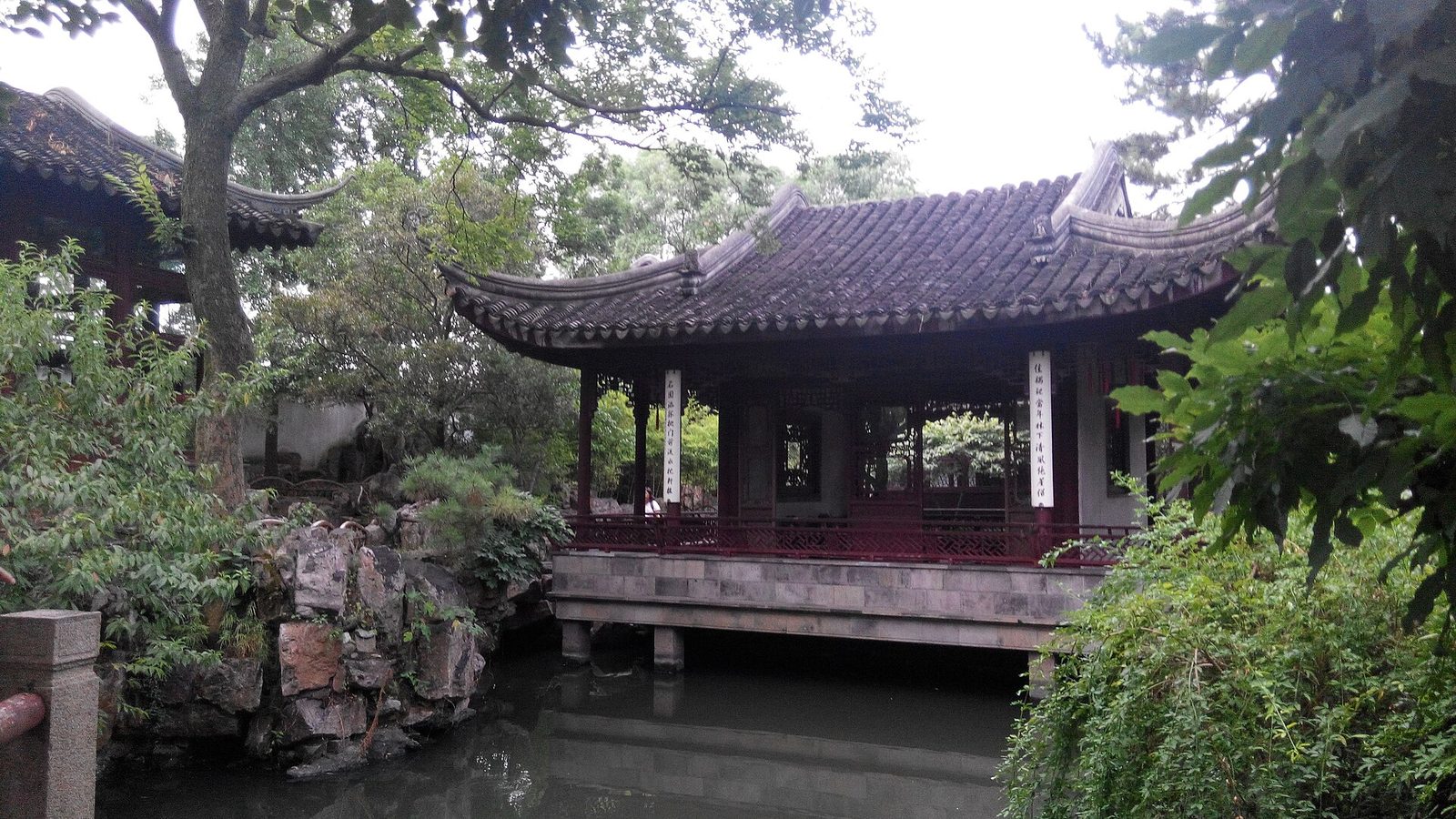
Suzhou's gardens are the city's greatest gift to the world. In 1997, the Humble Administrator's Garden, the Lingering Garden, the Master of the Nets Garden, and the Mountain Villa with Embracing Beauty were inscribed on the World Heritage List; in 2000, Canglang Pavilion, the Lion Grove Garden, the Garden of Cultivation, the Couple's Garden Retreat, and the Retreat & Reflection Garden were added — nine gardens, one philosophical system.
The key to the gardens is that they are not flower gardens but extensions of the residence, spiritual theaters of the literati. Piled rockeries and channeled water (re-creating wild nature within a few square yards with Taihu rocks and pools), framed and borrowed scenery (a single latticed window is a composition in itself), and inscribed plaques and couplets (every scene footnoted with a line of poetry) — the problem every garden-maker set out to solve was how to fit, on a city lot, a scholar's entire imagination of mountains and wilderness. The grandeur of the Humble Administrator's Garden (one of China's Four Great Gardens), the exquisiteness of the Master of the Nets Garden (night visits come with pingtan and Kunqu), and the hush of the Garden of Cultivation (the fewest visitors, the locals' favorite) are three expressions of the same grammar. The best rhythm for garden-going is two gardens a day, taken slowly — gardens are designed with the logic of "dwelling" and can only be read at the pace of "slow."
The Cultural Bedrock: Kunqu, Pingtan, and Su Craftsmanship
Kunqu opera was born in Kunshan, within today's Suzhou; refined by Wei Liangfu in the mid-Ming, it became the "ancestor of a hundred operas" — the vocal systems of Peking opera, Sichuan opera, and Cantonese opera all carry its genes. In 2001, Kunqu was among the first masterpieces proclaimed by UNESCO as "Masterpieces of the Oral and Intangible Heritage of Humanity." Suzhou today — the China Kunqu Opera Museum, the Kunqu Opera Theatre, the garden staging of Six Records of a Floating Life — remains the most authentic place to hear it. Pingtan is the background music of Suzhou daily life: soft Wu dialect plucked along by sanxian and pipa — steeping over a pot of tea in a storytelling house for a whole afternoon is the top specification of local retired life. Su craftsmanship — Su embroidery (whose supreme feat is double-sided embroidery), kesi silk tapestry, jade carving, Ming-style furniture — made "fine" the city's workshop standard, and the Suzhou Museum (I.M. Pei's final work, "Chinese yet new, Suzhou yet new") is the finest vessel for it all.
At the table, Suzhou is the sweet-leaning face of the Huaiyang school: squirrel-shaped mandarin fish, eel paste in sizzling oil, cherry pork — all about the season and the knife. Noodle culture peaks here: the "jiaotou" topping system of Suzhou-style soup noodles (braised pork belly, crisp-fried fish, shrimp, crab meat and roe) over the white broth of Fengzhen pork noodles, with the morning "first-broth noodles" as a ritual; and the season of "June yellow" young crabs and hairy crabs (Yangcheng Lake sits inside Suzhou) is Jiangnan's other way of measuring time.
Suzhou Today: The Strongest Prefecture-Level City
Suzhou has no airport and is not a provincial capital, yet it is "the strongest prefecture-level city" — GDP perennially in the national top ten, total industrial output of designated-size enterprises in the national top two, with nanotechnology, biopharmaceuticals, and artificial intelligence clustered here. Yet life inside the old town keeps its old tempo: noodle shops at dawn, pingtan storytelling houses, evenings at the Master of the Nets Garden, late-autumn red leaves on Tianping Mountain. This contrast between an economy at full throttle and a life at half speed is exactly what makes Suzhou so beguiling.
How to Feel This City
At dawn, a bowl of "first-broth noodles" at Tongdexing or Yuxingji; in the morning, into the Humble Administrator's Garden (go early — non-negotiable), with the Suzhou Museum next door (reserve ahead); at noon, walk the riverbank of Pingjiang Road slowly, ducking into side alleys for a xiekehuang "crab-shell" pastry; in the afternoon, head for the Master of the Nets Garden (if your dates fall in night-garden season, switch to the dusk performance of Kunqu and pingtan); then pick either Pan Gate or Shantang Street to see how the canal and the old city fit together. With one extra day, choose freely between Tiger Hill (King Helü and the Leaning Tower of the East) and the surrounding water towns (Tongli, Jinxi, Luzhi — quieter than Zhouzhuang).
Suzhou's pacing advice comes down to a single word: slow. This city's 2,500-year homework has been teaching people how, within a few square feet and arm's reach, to live a whole universe into ordinary days.
Frequently asked questions
When is the best time to visit Suzhou?
March–May (blossom season in the gardens) and September–November (osmanthus, ginkgo, and crab season) are ideal. The gardens reward a visit in any season, and the Humble Administrator's Garden and the Lingering Garden under fresh snow are trophy shots in photography circles.
How do I choose among the Suzhou gardens?
With limited time, pick the Humble Administrator's Garden (the largest and most complete) plus the Master of the Nets Garden (small and exquisite, with Kunqu performances in its night garden); for a deeper visit add the Lingering Garden, Canglang Pavilion, and the Garden of Cultivation. Avoid public holidays — the quality of a garden visit is inversely proportional to the number of people in it.