
Macau: A Living Specimen of Four Centuries of East-West Confluence
By PandaTrip Editorial · 7 min read · Verified 2026-09-06
Verified 2026-09-06
Of all the cities of China, Macau was the first to “open its eyes to the world” — 280 years before Hong Kong. In 1557 (the 36th year of the Jiajing reign of the Ming dynasty), the Portuguese were granted permission to settle on the Macau Peninsula, and the place became the first European settlement in East Asia and the bridgehead through which Catholicism entered the Chinese mainland. Matteo Ricci set out from Macau into the interior, carrying Western chiming clocks, maps, and mathematics into the studies of late-Ming scholar-officials. More than four hundred years later, this small city of roughly 33 square kilometers — among the most densely populated places on Earth — preserves China's most complete evidence of the early East-West encounter: in 2005, the “Historic Centre of Macau”, a continuous spatial ensemble of 22 buildings and 8 squares, was inscribed on the World Heritage List, making it one of the densest World Heritage areas in China.
From Settlement to “Macau”: How the City Got Its Name
The name Macau is itself a footnote to this history. As the story goes, when the Portuguese first landed on the peninsula they asked the fishermen in front of the A-Ma Temple what this place was called; the fishermen answered “A-Ma-Gau” (the temple of A-Ma, the goddess Mazu) — the Portuguese wrote it down as Macau, and the name has been in use ever since. This beautiful misunderstanding neatly sums up the four centuries that followed: the Western gaze and Eastern soil, misreading each other and shaping each other.
Under the Ming dynasty, Macau served as the outer port of Guangzhou's foreign-trade system and as the missionary center of Catholicism in East Asia; St. Paul's College (founded in 1594, China's first Western-style university) trained a cohort of scholars at home in both civilizations. In 1583 the Portuguese residents of Macau were permitted to establish a municipal council, and a tradition of self-government began. In 1887 the Qing government and Portugal signed the Sino-Portuguese Treaty of Amity and Commerce, by which Portugal obtained the right of “perpetual occupation and government of Macau”; on December 20, 1999, Macau was returned to China and became the second Special Administrative Region. After the gaming liberalization of 2002 brought international operators into the market, Macau overtook Las Vegas within a few years as the world's largest gambling city — but the gaming tables are only one face of Macau, and a late-arriving one at that.
The World Heritage District: Four Hundred Years You Can Read on Foot
The charm of the Historic Centre of Macau lies in its continuity and eclecticism: starting from the A-Ma Temple, past the Moorish Barracks and Mandarin's House (the former residence of the modern Chinese thinker Zheng Guanying, where his book Shengshi Weiyan, “Words of Warning in a Flourishing Age,” was written), across Senado Square and St. Dominic's Church, and on to the Ruins of St. Paul's — a twenty-minute walk that condenses four hundred years. A few coordinates you should not miss:
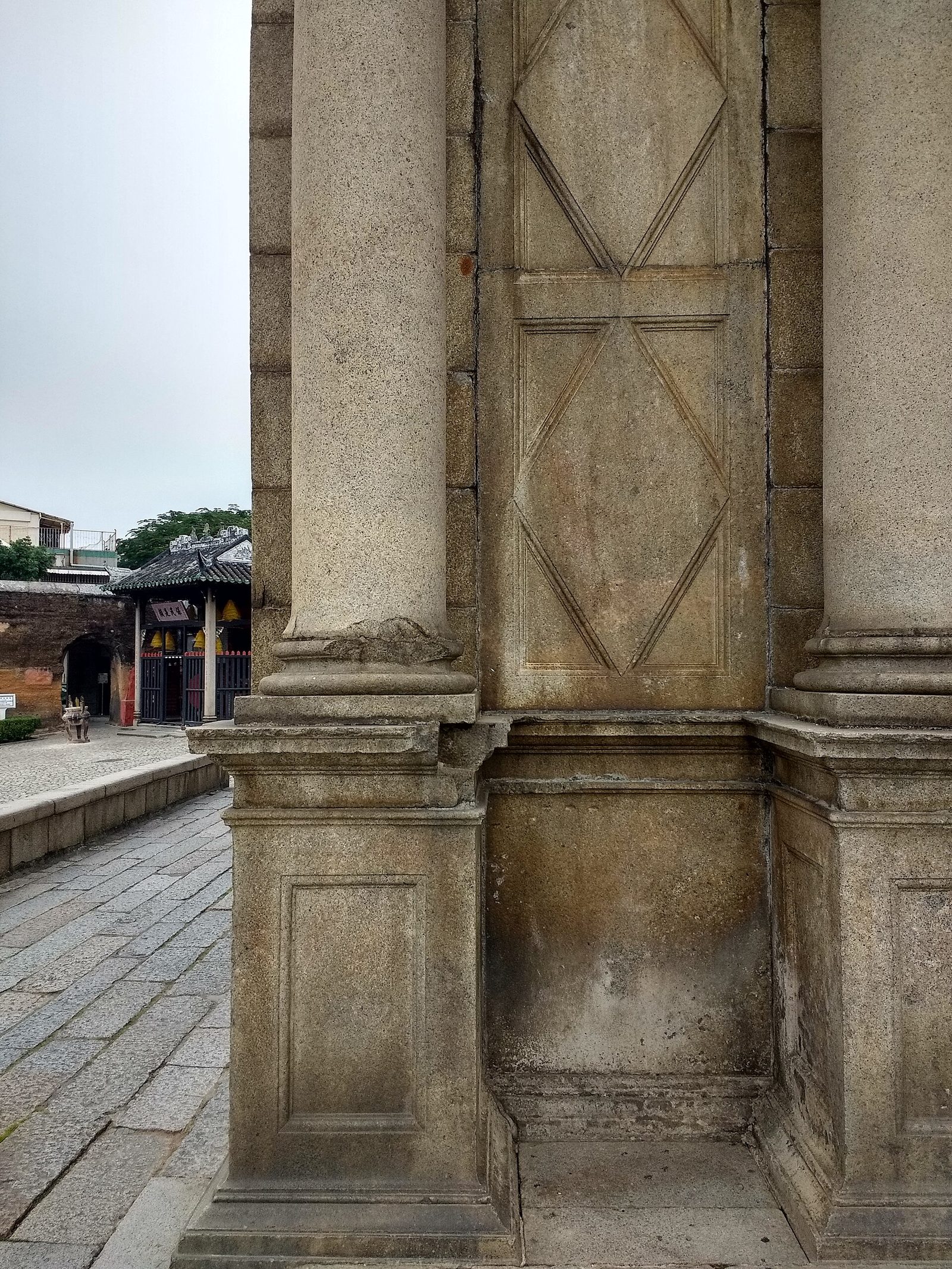
The Ruins of St. Paul's — the surviving front wall of the Church of St. Paul. Begun in 1602, the church went through three great fires; after the last one, in 1835, only this baroque stone façade remained, and it became the emblem of Macau. Carved into it are Chinese lions and chrysanthemum petals, a Japanese chrysanthemum, and a Portuguese caravel — one wall, motifs from four shores. The A-Ma Temple — the starting point of Macau's name and one of the centers of Mazu worship along the South China coast, its incense unbroken to this day. Guia Fortress and Lighthouse — the first modern Western-style lighthouse on the Chinese coast (first lit in 1865), standing on the highest point of the Macau Peninsula. Dom Pedro V Theatre — completed in 1860, China's first Western-style theater. Senado Square — a plaza paved with wave-patterned calçada paving, black and white stones set in rolling patterns and flanked by buildings in soft southern-European colors: the “most Portuguese” picture Macau has to offer.
Beyond the peninsula, the Taipa Houses–Museum on Taipa and, on Coloane, the Chapel of St. Francis Xavier and the old fishing-village streets show Macau at a slower pace.
Macanese Culture: A Hybrid Language, Faith, and Table
Macau's most distinctive cultural creation is the Macanese community — descendants of Portuguese who intermarried with Chinese, Malays, and Indians. They speak a “Macanese patois” that blends Portuguese, Cantonese, and Malay (only a handful of speakers remain, and it is listed as an endangered language), and they are Catholic while observing many Chinese festival customs. Their table produced Macanese cuisine — a fusion cuisine that has earned a place on UNESCO's intangible heritage list: African chicken (baked in a piquant sauce), Portuguese chicken (in fact a Macanese invention — no such dish exists in Portugal), minchi (minced meat with diced potato), and bacalhau (salted cod) in a hundred preparations.
Macau's everyday flavors run on two tracks, Chinese and Portuguese, over a Cantonese base: Portuguese egg tarts (in 1989 the Englishman Andrew Stow opened a bakery in Coloane and reworked Portugal's pastéis de nata into a flaky-pastry version; after the two later parted ways, Lord Stow's and Margaret's each commanded their own following), pork chop buns (a charcoal-grilled pork chop in a crisp bun, a Taipa classic), water-crab congee, almond cookies, and bamboo-pressed noodles. Grazing your way along the souvenir streets (Rua do Cunha, Travessa do Auto Novo) until your hands are full of sample boxes is the standard visitor's circuit. As for money, the Macau pataca (MOP) and the Hong Kong dollar circulate side by side, and Hong Kong dollars are accepted everywhere in Macau (converted at about 1.03, with change usually given in patacas).
Macau Today: The Second Curve Beyond the Casino City
Gaming tax long accounted for more than 80 percent of Macau's public revenue, and the city's reinvention is the most discussed topic of recent years: cultural tourism (the historic center, and racing — the Macau Grand Prix, first run in 1954, is one of the most famous street races in the world), the convention and performance economy (The Londoner Arena and Galaxy Arena stage productions of international scale), and Chinese medicine and big health (the Guangdong–Macau In-Depth Cooperation Zone in Hengqin) have been named the “three arrows” of economic diversification. For travelers, Macau today is this: the giant resort clusters of the Cotai Strip (the Venetian, the Parisian, the Londoner — a surreal comic strip assembled from an indoor canal and a replica Eiffel Tower) and the street-level warmth of the old town on the peninsula, in the same city, a bridge apart.
The locals' self-deprecating line about their identity says it all: “We're a small place with a long history.” True enough — four hundred years of East-West history are stacked onto 33 square kilometers, and you can read them on foot; nowhere else in East Asia offers a second example.
How to Feel the City
Start at the A-Ma Temple and follow the World Heritage route up to the Ruins of St. Paul's, pausing at Senado Square for a coffee while you watch the calçada paving go by; in the afternoon cross to Taipa for a pork chop bun and egg tarts on Rua do Cunha, then walk on to the Taipa Houses–Museum for the mangrove wetlands and the old official residences; at dusk head for Coloane, where evening light on the square in front of the Chapel of St. Francis Xavier, paired with an egg tart from the original Lord Stow's Bakery, is the most consoling finale Macau can offer; after dark, return to Cotai and treat the resorts as architecture — catch a large resident show, or simply stroll beneath the Venetian's painted sky. If casinos hold no appeal for you, you can happily tour them as a free museum of architecture.
One last practical tip: Macau is built on the scale of a “walking city,” and the old peninsula town needs no transport at all; the resorts, however, are far apart, so make good use of the free shuttle buses (the casino shuttles are the most reliable public transport in all of Macau).
Frequently asked questions
Is Macau's entry policy different from mainland China's and Hong Kong's?
Yes — the three are mutually independent. Macau grants visa-free entry or visa-on-arrival to most passports (stays of 14 to 90 days depending on nationality), so a passport is all you need; mainland residents use the Exit-Entry Permit for Hong Kong and Macau, and mainland visas held by foreign travelers do not work here. Arriving from the mainland or from Hong Kong each counts as a separate entry into Macau. Before you travel, confirm the details on the official website of Macau's Public Security Police Force.
Can Hong Kong and Macau be covered in one trip?
Yes — a common combination is 2–3 days in Hong Kong plus 1–2 days in Macau. The TurboJET ferry between the two takes about 1 hour, or you can take a direct bus across the Hong Kong–Zhuhai–Macau Bridge; between the Macau Peninsula and Taipa there are the light rail (LRT) and free casino shuttle buses.