
"Hong Kong: A Century and a Half of East Meets West on the Shores of Victoria Harbour"
By PandaTrip Editorial · 8 min read · Verified 2026-09-06
Verified 2026-09-06
Hong Kong may be the most "dense" city in the world — not in population density, but in density of meaning. Victoria Harbour is barely one to two kilometers wide, yet packed along its shores are one of the world's most spectacular skylines, one of its busiest financial centers, its most unpretentious cha chaan tengs and tong lau tenements, and every layer of strata left by 170 years of Chinese-Western collision. It is a Special Administrative Region of China, yet it speaks Cantonese and English, pays in Hong Kong dollars and rides in right-hand-drive cars; it lived through a colonial history, yet after the 1997 handover it has carried on under "One Country, Two Systems," running another system of its own. Understanding Hong Kong is not about deciding whether it is "more Chinese or more Western" — it is about seeing how it blended the two into a logic entirely its own.
From Fishing Village to Far Eastern Entrepôt
Hong Kong's story is often reduced to "tiny fishing village becomes international metropolis," but the real version has far more layers. Before the port opened, this land belonged to Xin'an County — a place of farming, fishing, and salt-making on the eastern shore of the Pearl River estuary, home to indigenous villages thousands of years old (the walled villages and ancestral halls of the New Territories still stand today). In 1841, during the First Opium War, British forces occupied Hong Kong Island; in 1842, the Treaty of Nanking formally ceded it. Britain then took the Kowloon Peninsula south of Boundary Street in 1860, and in 1898 forcibly leased the "New Territories" — from Boundary Street north to the Shenzhen River — for 99 years. The expiry date of that lease planted the seed of the Sino-British negotiations nearly a century later.
Free-port status quickly raised Hong Kong into an entrepôt: beyond opium and silver, the most consequential trade was in people. The Taiping Rebellion, the 1911 Revolution, the War of Resistance Against Japan, the Chinese Civil War — every upheaval on the mainland pushed capital, labor, and entrepreneurs toward Hong Kong. When the UN embargo on China in the 1950s gutted the entrepôt trade, Hong Kong turned disaster into a pivot toward manufacturing: "Made in Hong Kong" textiles, plastic flowers, wigs, and digital watches sold across the globe, and the "Lion Rock spirit" of the 1960s–70s was born of exactly this. After China's reform and opening-up in 1978, Hong Kong turned once more, becoming the mainland's bridge to the world: finance, property, and professional services soared; in the 1980s–90s the city joined the front rank of global financial centers, and in those same years exported a popular culture that shaped the entire Chinese-speaking world.
On July 1, 1997, Hong Kong was returned to China, becoming the first Special Administrative Region to implement "One Country, Two Systems." In the years since, the city has lived through the Asian Financial Crisis, SARS, the post-crisis era of the Individual Visit Scheme, and the social storms and rebuilding of recent years — today's Hong Kong remains a front-rank global IPO center and the offshore hub of the renminbi, the most international link along the Greater Bay Area's C-shaped coastline.
Urban Form: A Vertical City Squeezed Between Mountains and Sea
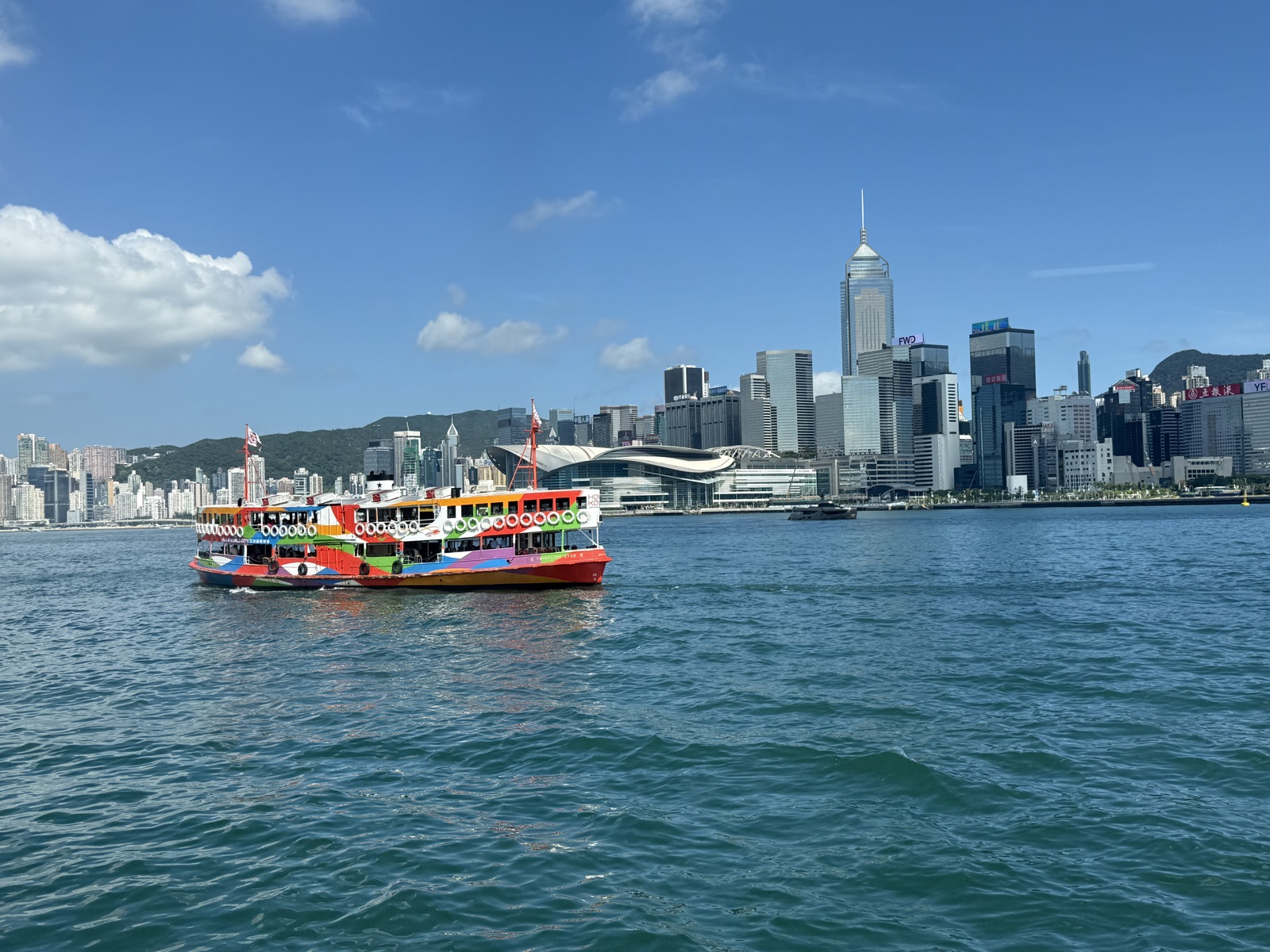
Hong Kong's geographic skeleton is "lots of mountains, little flat land": of the territory's 1,100-plus square kilometers, only a quarter is developed — which squeezed out a vertical city form rarely seen anywhere on Earth. Across the harbour, the north shore of Hong Kong Island and Tsim Sha Tsui face each other and compose the city's front cover; the Central–Mid-Levels escalator in Central (the world's longest covered escalator system) turns hillsides into neighborhoods; the ding-ding (the double-decker tram, running since 1904) has clanged along the island's north shore for twelve decades; and the Star Ferry, crossing since the late nineteenth century, still ferries you across Victoria Harbour for a few coins — perhaps the best-value "urban observation deck" on the planet. Housing advances on sky and slope at once: public rental estates, Home Ownership Scheme flats, and luxury towers together form a forest of buildings of astonishing density — and the most classic frame in Hong Kong cinema.
The squeeze of mountain and sea gave Hong Kong another identity too: three-quarters of its land is countryside. Thanks to 24 country parks, this is a city where you can hold a meeting in Central in the morning, surf at Tai Long Wan in the afternoon, and eat seafood in Sai Kung at night. Hiking the country parks is the weekend ritual locals take most seriously, and the MacLehose Trail is a pilgrimage route for hikers from around the world.
Cultural Bedrock: An Everyday System Where Chinese and Western Mix
The essence of Hong Kong culture sits not in museums but in the systems of daily life. The cha chaan teng (Hong Kong-style café) is the finest specimen of that system: silk-stocking milk tea (a tea base pulled again and again through a cloth filter until silky), yuenyeung (coffee blended with milk tea), the pineapple bun with butter, French toast — Chinese ingredients, Western methods, Southeast Asian influences, local improvisation: a "fusion" that had been running for decades before the word became fashionable. The yum cha tradition of "one pot of tea, two dim sum" (har gow, siu mai, char siu bao) and the wet-goods stalls of the street markets are the roots of Cantonese life; the glistening char siu hanging in the windows of roast-meat shops is the base color of Hong Kong's streets.
In language, Cantonese reigns absolute, yet mixing Chinese and English is the default of local speech ("kai go meeting," "m'goi sai" — "thanks a lot"). Cantopop is Hong Kong's greatest export to the Chinese-speaking world: from Sam Hui to Beyond, from Leslie Cheung and Anita Mui to the Four Heavenly Kings, forty golden years of Cantonese song shaped the emotional grammar of generations; Hong Kong cinema wrote the city's urban spaces into world film history — Stephen Chow's mo lei tau nonsense, Wong Kar-wai's neon nights, Jackie Chan's rooftops on old tenements: all self-portraits of this city.
Faith and folklore are just as hybrid: the incense of Wong Tai Sin Temple, the bun-scrambling of the Cheung Chau Jiao Festival, the Tai Hang fire dragon dance, the spinning windmills of Che Kung Temple — all coexist seamlessly with Lan Kwai Fong on Christmas Eve and camping on the outlying islands at Easter. The city's pragmatic theology: go to whichever temple delivers.
Hong Kong Today: A Financial Capital Writing a New Cultural Chapter
Hong Kong today has about 7.5 million residents, a GDP per capita among the world's highest, and has sat near the top of global financial center rankings for years. The city's newest chapter is being written in the West Kowloon Cultural District: the M+ museum of visual culture (opened 2021) and the Hong Kong Palace Museum (opened 2022) have grown new cultural landmarks at the harbour's western end, while Kai Tak Sports Park, opened in 2025, hosts mega-concerts and the events of the 15th National Games. To the north, the Lok Ma Chau Loop is rising as a Shenzhen–Hong Kong innovation and technology cooperation zone; to the west, the Hong Kong–Zhuhai–Macao Bridge (opened 2018) and the high-speed rail West Kowloon Station (where mainland and Hong Kong border inspection are carried out in one station under "co-location") have locked Hong Kong into the Greater Bay Area's one-hour living circle — from Shenzhen North to West Kowloon takes just over ten minutes, and a tale of two cities has become daily life for many.
How to Feel This City
At dawn, eat a pineapple bun with butter and a silk-stocking milk tea in a Central cha chaan teng, watching office workers share tables with grandmothers; in the morning, take the Star Ferry from Tsim Sha Tsui to Central and read Victoria Harbour the cheapest way there is; in the afternoon, go up Victoria Peak (the Peak Tram is an antique that has run since 1888) and wait out a full skyline from daylight to dusk; at dusk, ride the ding-ding from Shau Kei Wan all the way to Sheung Wan and drink in the street life of the island's north shore; at night, head for the dai pai dongs of Temple Street, or simply take the ferry to Cheung Chau and stay overnight to see Hong Kong's fishing-village face once the financial mask comes off. Hikers, save a day for the Dragon's Back or Lion Rock — from the ridge, looking out over Victoria Harbour, you will understand that "Pearl of the Orient" is, before anything else, a geographical fact.
Two practical notes to close: Hong Kong's cha chaan tengs and small market stalls still run mainly on cash and the Octopus card — Alipay and WeChat Pay are common in chain stores, but don't count on full coverage. Is Cantonese hard? One phrase — "m'goi" (m̀hgōi, excuse me/thank you) — will carry you through eighty percent of social situations.
Frequently asked questions
Is Hong Kong's entry policy the same as mainland China's?
No — Hong Kong runs its own independent immigration control. Passport holders of most countries can enter Hong Kong visa-free (permitted stays range from 7 to 180 days depending on nationality), and this is entirely separate from mainland China's visa regime: traveling from the mainland to Hong Kong counts as a separate entry, and returning to the mainland means meeting the mainland's entry conditions again. Your passport alone is enough — no Exit-Entry Permit for Hong Kong and Macao is needed (that is a document for mainland residents). Before you travel, check the website of Hong Kong's Immigration Department to confirm the policy for your nationality.
When is the best time to visit Hong Kong?
October through February is dry and sunny — the best season; March and April bring the damp “returning south” humidity; July to September is hot with occasional typhoons (when Typhoon Signal No. 8 is hoisted, the whole city shuts down — which is an experience in itself).