
Does Cash Still Matter in China? A Guide to Currency Exchange, ATM Withdrawals, and Leftover Yuan
By PandaTrip Editorial · 3 min read · Verified 2026-09-06
Verified 2026-09-06

"Do I really not need any cash in China?" — Mostly true, but not 100%. China has the world's highest mobile-payment penetration, and precisely because locals carry no cash, cash payments occasionally stall at the change-making step. This guide explains the real status of cash: when you must use it, where to exchange it, how to withdraw it, and what to do with what's left over.
The Three Real Uses of Cash
- Emergency fallback. Dead phone battery, a payment app triggering a risk-control check, poor signal, exhausted limits — banknotes are the always-available final means of payment, and the only one that depends on no system at all.
- Specific scenarios. Some taxis take cash or local QR codes only; small stalls in old town districts, temple incense offerings, and buses in remote areas all run more smoothly with cash.
- Bargaining situations. At wet markets and small-commodity markets, cash still works best when haggling over price.
Chinese regulations explicitly state that merchants may not refuse RMB cash; if one does, note the merchant's details and call the 12363 hotline to complain. But complaining is a right, not an experience — preparing in advance is more practical.
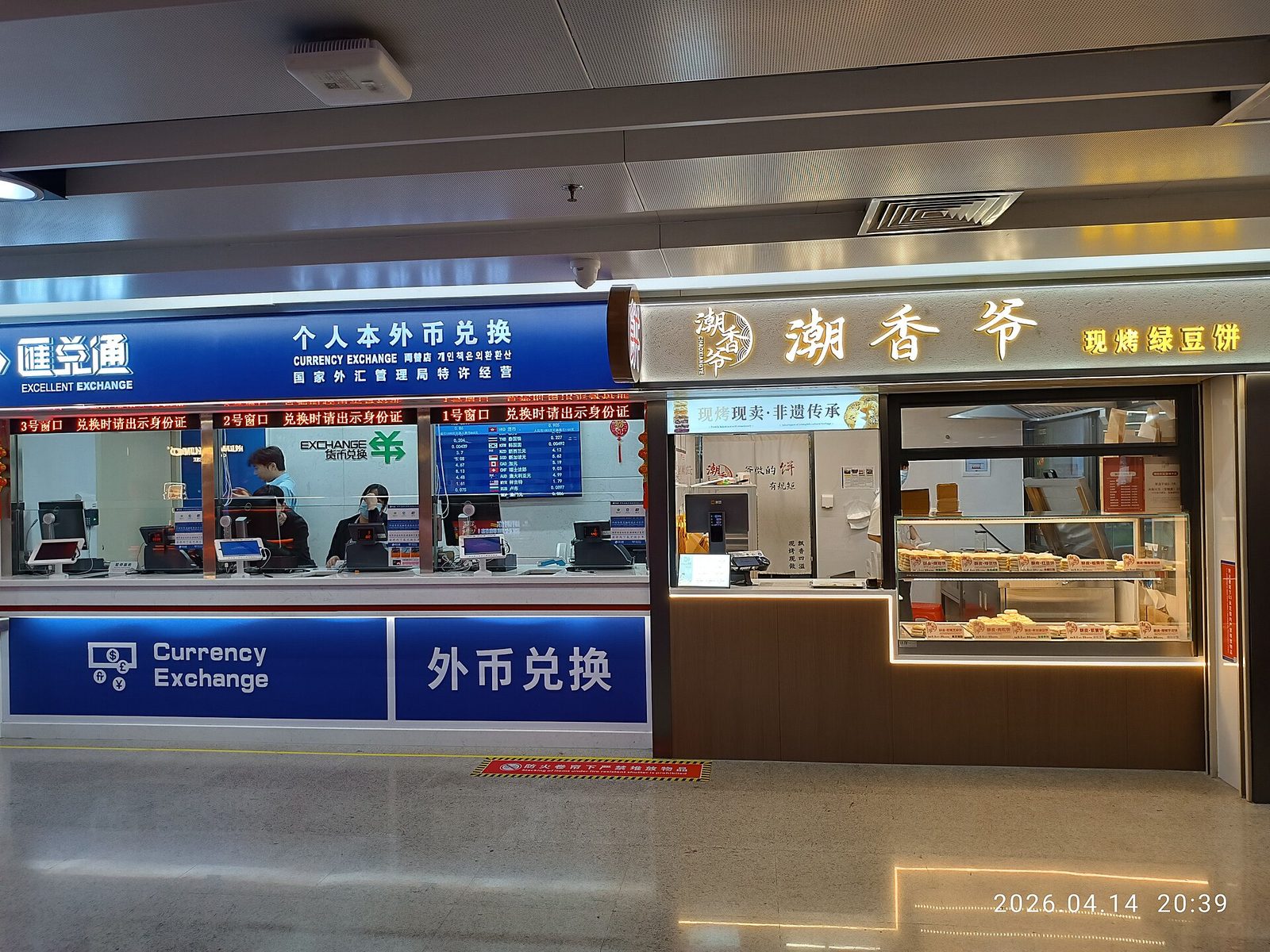
Exchanging Money: Where and How Much
- Airport exchange counters: the most convenient and the worst rates — only worth it for an emergency US$100–200.
- Bank branches: major branches of Bank of China, ICBC, and China Construction Bank all handle currency exchange. Fill in an exchange form with your passport and settle at the day's posted rate — the best rate among legitimate channels. Four-star hotels and above also offer exchange, at rates between the airport's and the banks'.
- Recommended amount: for a 10-day trip, ¥300–500 in cash is enough, a good share of it in ¥10, ¥20, and ¥50 notes. When exchanging, ask the teller directly to mix in small denominations.
ATM Withdrawals: Look for the Right Logos
ATMs bearing Visa / Mastercard / UnionPay logos are everywhere in China — in bank branches, shopping malls, and metro stations. A withdrawal involves three fees: your issuing bank's overseas withdrawal fee, the card network's fee, and the surcharge some Chinese ATMs add. Since the fixed cost per withdrawal is not trivial, the strategy is fewer withdrawals, larger amounts: taking out ¥500–1000 at once beats withdrawing ¥100 a day.
Some ATMs do not recognize foreign cards (especially at small banks and on older machines) — just try another one; ICBC, Bank of China, and China Merchants Bank machines are the most compatible. Withdrawal limits are set by your issuing bank; within China, they generally do not exceed the equivalent of ¥10,000 per day.
The basic principle stands: cash is the backup, not the mainstay. Withdraw ¥1000 as a reserve and pay by QR code as usual — that's the most hassle-free combination.
Exchange Rates and Alipay's Conversion Feature
Before exchanging, check the live rate in the exchange-rate calculator in the PandaTrip Toolbox (updated hourly) so you know what to expect. Alipay has a built-in "Exchange" feature that supports reservations for small amounts of foreign-currency cash (for pickup at branches in some cities) — useful when you need to top up cash unexpectedly; rates are middling. WeChat has no equivalent.
Before Departure: Dealing with Leftover Yuan
Three options:
- Convert back to foreign currency: with your passport and exchange receipt at branches such as Bank of China; the amount is generally capped at what you originally exchanged — keep the receipt from every exchange.
- Spend it: airport duty-free shops and gift shops are the right places to zero out the odd bills.
- Save it for next time: RMB banknotes never expire — if you're sure you'll be back, just keep them.
One final note: cash usage in China keeps declining, and some young shop assistants may not have handled a banknote in months. If the person hesitates when you hand over cash, it is usually not a refusal — they're simply unfamiliar with making change.
Frequently asked questions
Which cash denominations are most useful in China?
¥10, ¥20, and ¥50 notes are the most practical. Street vendors and taxis often cannot break a ¥100 note; anything under ¥5 is rarely needed, but keep a few notes for the bus.
Can I change leftover yuan back into foreign currency when leaving China?
Yes. With your own passport and the original exchange receipt, you can convert yuan back into foreign currency at branches such as Bank of China, generally up to the amount you originally exchanged. Always keep your receipts for large exchanges.