
Beijing: Three Thousand Years Along the Central Axis
By PandaTrip Editorial · 7 min read · Verified 2026-09-06
Verified 2026-09-06

Beijing is a city written along a single line. On July 27, 2024, "Beijing Central Axis: A Building Ensemble Exhibiting the Ideal Order of the Chinese Capital" was inscribed on the World Heritage List, becoming China's 59th World Heritage property. The 7.8-kilometer line runs south from Yongdingmen to the Bell and Drum Towers in the north, threading the Temple of Heaven, Zhengyangmen, Tiananmen, the Forbidden City, Jingshan, Wanning Bridge, and the Drum Tower — for seven hundred years, Beijing's most important buildings have stood along its flanks like a three-dimensional treatise on ritual order. Learn to read this line, and you have read half of this three-thousand-year-old city.
From the Ancient City of Ji to Dadu: A Capital Founded Twice
Beijing's urban history runs back more than three thousand years: in 1045 BC, the Zhou dynasty enfeoffed the Duke of Shao at Yan, and the ancient city of Ji — the predecessor of today's Beijing — stood at the northern edge of the North China Plain, on the seam between the farming world and the nomadic world, a position that determined everything that followed. It first existed as a military stronghold (Jixian county under the Qin and Han, Youzhou under the Tang, and Nanjing, the secondary capital of the Liao); in 1153, the Jin dynasty moved its capital here under the name Zhongdu, and for the first time Beijing became the political center of a dynasty — the point from which its eight-hundred-plus years as a capital are counted.
The true founder was Kublai Khan. From 1267, Dadu of the Yuan dynasty was planned from the ground up on the ideal-capital blueprint of the Kaogongji chapter of the Rites of Zhou: a square walled city, symmetry about a central axis, court in front and market behind, ancestral temple on the left and altars of soil and grain on the right — the skeleton of Beijing's old city today was set in place then. The "Khanbaliq" (Dadu) of Marco Polo's account was among the grandest cities of its age. In 1420, Ming Chengzu, the Yongle Emperor Zhu Di, moved the capital to Beijing and built the Forbidden City; the Qing dynasty took over the Ming city wholesale. Hence the city we see today: one central axis, one Forbidden City, an inner and an outer walled town, and temples and altars set out in symmetrical pairs.
After the last Qing emperor abdicated in 1912 and the Nationalist government moved its capital to Nanjing in 1927, Beijing (renamed Beiping in 1928) spent more than two decades settling into its identity as a historic cultural capital — Peking University, Tsinghua, and a generation of scholars made the "Beiping period" a major chapter in China's cultural history. After 1949, when the capital returned to Beijing, the city grew new ring roads and the face of an international metropolis beyond the old walls, while the old city itself became a living, still-breathing historic quarter.
A City of Ritual and a City of Everyday Life
Beijing keeps two faces: one for Heaven, Earth, and the ancestors, and one for rice, salt, and daily bread.
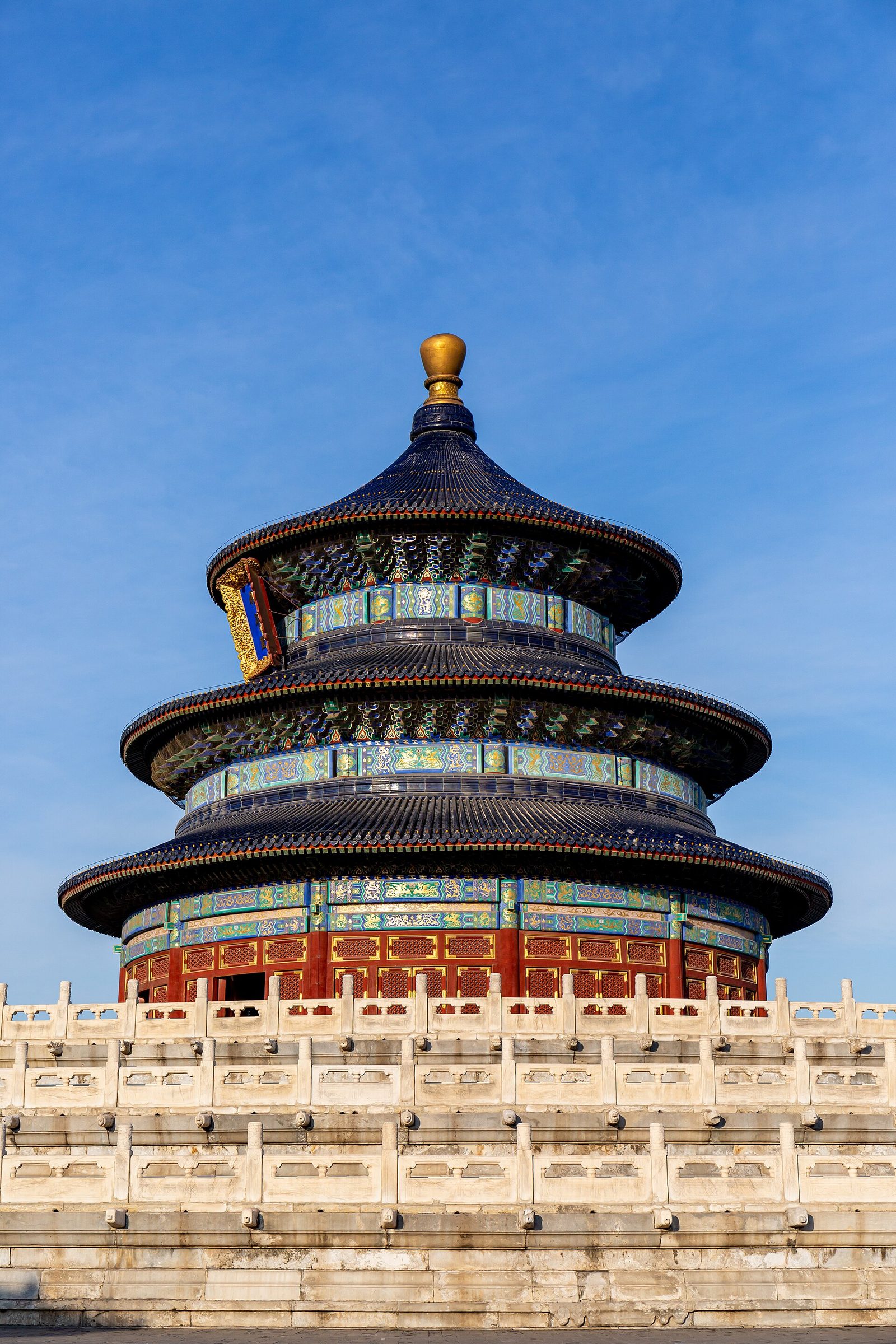
The city of ritual concentrates on the Central Axis and its flanks: the Forbidden City (the Palace Museum, a World Heritage Site and the largest surviving complex of timber architecture on earth — within its 720,000 square meters, twenty-four emperors of the Ming and Qing lived and ruled); the Temple of Heaven, where the emperor conversed with Heaven, its Hall of Prayer for Good Harvests crowned by a triple-eaved circular cone roof that is a signature silhouette of Chinese architecture; and the Imperial Ancestral Temple, the Altar of Land and Grain, the Confucius Temple, and the Imperial College (Guozijian) ranged along the two wings. The subject of this layout is "order": imperial power, divine authority, and ethics each in their appointed place — Beijing is ritual order projected into three dimensions.
The city of everyday life hides in the gaps of ritual: the hutong–siheyuan courtyard system is the part of Dadu's plan that was handed over to ordinary life. The word "hutong" is generally held to derive from a Mongolian word for "water well" (hottog); under the Yuan dynasty's "eight mu to a plot" rule, house lots were laid out with hutong running dead straight and siheyuan courtyards facing south. At its height Beijing counted several thousand hutong, their soundtrack the street cries of barbers, knife-grinders, and candied-hawthorn (tanghulu) sellers. The best-preserved quarters today (Nanluoguxiang, Shichahai, Dongsi, and the Yangmeizhu Xiejie area) remain the gateway to the city's street life — much of it now dressed up in "cultural-creative" retail, but the hutong at daybreak still belong to the old men walking their caged songbirds and the children on their way to school.
Beijing-Flavor Culture: Fastidious and Easygoing at Once
The temperament of Beijing culture is a blend of "juqi" (the local ideal of standing by your own people, generous and square-dealing) and "jiangjiu" (getting every detail right). In language, the Beijing dialect's rolled "-r" endings and slang carry an unstudied humor ("nin cai zenme zhao" — "guess what happened"; "de-lei" — "you got it"); it is the easiest dialect in the country to understand, and the easiest to mangle in imitation. Peking (Beijing) opera took its finished form here after the Anhui troupes came north in 1790 — the xipi and erhuang modes, the sheng, dan, jing, and chou role types — and still plays regularly at the Huguang Guild Hall and the Liyuan Theatre; xiangsheng crosstalk, from the open-air pitches of Tianqiao to the theaters of Deyunshe, is this city's sense of humor in its contemporary form. Beijing literature, from Lao She's "Rickshaw Boy" and "Teahouse" down to Wang Shuo, has always written this city's dignity and its dishevelment in the crevices of the times.
Food is just as polarized. At one pole sits Beijing roast duck, the legacy of official-house cuisine (guanfucai), with its two schools of hung oven and closed oven — Quanjude and Bianyifang the standard-bearers — together with imperial snacks such as pea-flour cake (wandouhuang) and kidney-bean rolls (yundoujuan). At the other pole is the street: luzhu huoshao (bread rolls simmered in tripe broth), chaogan (thick liver stew), douzhi (fermented mung-bean drink) with jiaoquan (crisp fried dough rings), and baodu (flash-fried tripe) — the sour, funky tang of douzhi is the taste line between outsiders and locals: dare to drink it and find it fragrant, and Beijing counts you half a native.
Beijing Today: A Capital Twice Over
Beijing today holds about 21 million permanent residents and is the nation's political center, cultural center, international exchange center, and center for scientific and technological innovation — four designations that shape the cityscape: the international polish of Sanlitun and the Guomao CBD, the tech density of Zhongguancun, the avant-garde art of 798 and Caochangdi, and an unbroken density of museums (the Palace Museum, the National Museum of China, the Capital Museum, the National Art Museum of China, UCCA, and more). The 2022 Winter Olympics made it the world's first "dual-Olympic city."
The newest chapters of urban space are being written beyond the old city: the municipal sub-center at Tongzhou, Daxing International Airport (a Zaha Hadid design ranked among the "new Seven Wonders of the World"), and green necklaces of parkland strung beyond the Fourth Ring Road. And over it all, the seven-hundred-year-old Central Axis still holds — since the successful 2024 World Heritage bid, points along it, from the Xiannongtan (Temple of Agriculture) with its "one mu, three fen" imperial plot to Zhengyangmen, have opened to the public one after another; to walk this line end to end is to walk the history of China's capital-city civilization from the Yuan dynasty to today.
How to Feel the City
Walk a condensed Central Axis in one day: start at first light from Yongdingmen, pass the Temple of Heaven (go early for the morning exercisers and the Echo Wall), cross Zhengyangmen and Tiananmen Square, enter the Forbidden City and walk it south to north (reserve well ahead; before closing, climb to the Wanchun Pavilion on Jingshan and look back over the full panorama of the palace — Beijing's single most classic view), come down and follow Di'anmen Outer Street to the Drum Tower, and have dinner in the hutong between the Bell and Drum Towers. Give another day to the Great Wall (Mutianyu for thinner crowds and finer views; Badaling for the easiest transit) and the Summer Palace (dusk over Kunming Lake with the Seventeen-Arch Bridge). Leave the rest of your time to the hutong: morning at Shichahai, afternoon at Wudaoying, dusk along Yangmeizhu Xiejie, with a cup of douzhi or a craft beer — this city serves both flavors.
Frequently asked questions
When is the best time to visit Beijing?
Spring and autumn (April–May and September–October) are the most comfortable; autumn's ginkgo gold and red leaves are a limited-season spectacle. Winter is dry and cold but uncrowded, and the Forbidden City under snow is the rarest picture of the year. Summer is muggy and rainy.
How do I book the Forbidden City and other hot attractions?
The Forbidden City releases tickets at 20:00 seven days in advance, and on holidays they sell out within minutes — set an alarm without fail. The National Museum of China is free but requires a reservation. For full rules and ticket-grabbing tactics, see our guide “Attraction Tickets and Reservations in China”.