
Zhangjiajie: The Real-Life Floating Mountains of Avatar and the Gateway to Xiangxi
By PandaTrip Editorial · 6 min read · Verified 2026-09-06
Verified 2026-09-06

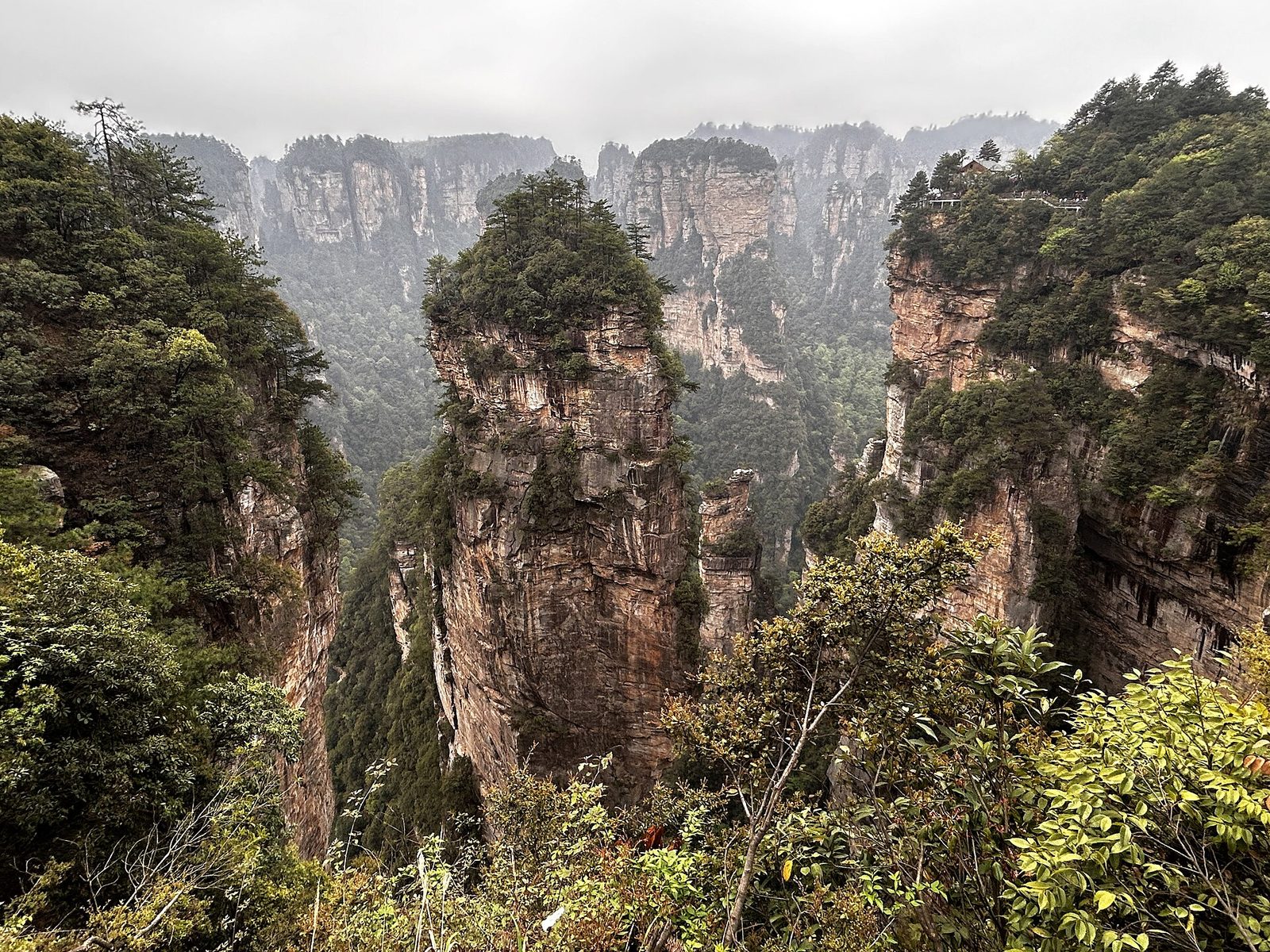
In the film Avatar (2009), Pandora's floating mountain ranges are breathtaking. One of the real-world references behind director James Cameron's inspiration was the quartzite sandstone peak forest of Zhangjiajie in China's Hunan Province — in January 2010, a pillar in the Wulingyuan Scenic Area originally known as “Pillar of the Southern Sky” was officially renamed “Hallelujah Mountain”, sealing this transpacific bond. But for those in the know, Zhangjiajie never needed a movie to make its name: more than 3,000 stone peaks rising sheer from the ground form a geological wonder unique on this planet.
A Geological Script 300 Million Years in the Making
Zhangjiajie's story begins about 380 million years ago, when this area was a shallow sea by the coast. Sand and mud settled layer upon layer and were compressed into hard quartzite sandstone — more than 500 meters thick, the raw material of all the wonders to come. The script that followed unfolded in three acts:
Uplift. Over some 200–300 million years, tectonic movements lifted the area from seabed to land; during the Yanshan–Himalayan orogenies, the block rose again in violent surges, forming a highland plateau. Dissection. Flowing water cut down along the rock's vertical joints (fissures), gravity-driven collapses followed, cracks became gullies, and gullies became canyons. Sculpting. Wind, water and biological weathering kept polishing, until the whole plateau was carved into what we see today: stone peaks standing like a forest, walls sheer and vertical — the tallest over three hundred meters, the slimmest only a few, each peak standing alone yet together forming a forest of peaks.
This kind of “sandstone peak-forest landform” is found almost nowhere else on Earth — elsewhere stone forests are mostly limestone (karst landforms); Zhangjiajie alone is a peak forest that flowing water carved from quartzite sandstone. In 1992, Wulingyuan (comprising Zhangjiajie National Forest Park, Suoxiyu, Tianzi Mountain and Yangjiajie) was inscribed as a World Natural Heritage Site for its near-pristine geological and ecological values; in 2004 it also became one of the world's first Global Geoparks.
Administratively, Zhangjiajie City is a prefecture-level city created in 1988 to manage this landscape (formerly Dayong City, renamed in 1994) — the youngest city on the map of Hunan, a city born of scenery.
From Forestry Farm to National Park: The Origin of Modern Chinese Tourism
Few realize that Zhangjiajie is also the birthplace of China's national park concept: in 1982, the State Council approved the establishment here of China's first national forest park — Zhangjiajie National Forest Park. Its predecessor was, remarkably, a state-run forestry farm: established in 1958, the Zhangjiajie Forestry Farm was kept “closed to the axe” by the insistence of its then director Liu Kailin through the era of felling, leaving an intact forest for later generations. That forest is now the base tone beneath the peaks: Wuling pines grow from crevices on the summit cliffs, ancient trees tower in the valley bottoms, troops of rhesus macaques roam, and negative oxygen ion levels stay off the charts all year.
Beneath the Peaks: The Tujia World of Xiangxi
The peak forest is Zhangjiajie's face; its human culture is the base tone. The Tujia people (about half the local population) have lived here for generations, alongside Bai and Miao communities. The Tujia call themselves “Bizika”; their language belongs to the Tibeto-Burman family and has no script of its own. Their signature architecture is the stilted house (diaojiaolou) built against the mountain slopes; their signature weave is Xilankapu (Tujia brocade); their most beautiful folk customs are the “crying marriage” and the baishou dance — the former a months-long repertoire of “weeping songs” to thank one's parents and bid farewell to girlhood, the latter a whole-village circle dance of ritual and festival. The Sheba Festival and “Gannian” (celebrating the New Year one day ahead of the Han Chinese Spring Festival, said to date from Tujia soldiers setting out to fight the wokou, Japanese pirates, in the Ming dynasty) are all living customs.
The food is classic Xiangxi: sanxiaguo stew (cured pork, tofu and radish stewed in one pot, said to have begun as Ming-dynasty soldiers' field cooking), rock ear (yan'er) stewed with free-range chicken, congjun mushrooms and sour pickled vegetables — “spicy” and “smoke-cured” are the keywords. Relatively authentic versions can be found around the city proper, Laodaowan and Xibu Street.
Three Ways to Read the Mountains: Forest Park, Tianmen Mountain, Grand Canyon
The three major scenic areas within Zhangjiajie's boundaries have entirely different characters:
Wulingyuan (Zhangjiajie National Forest Park) is the absolute lead. Tickets are valid for four days: hike the length of Golden Whip Creek, see “Hallelujah Mountain” at Yuanjiajie, watch the sunrise over the peak forest from Tianzi Mountain, walk the wild trails of Yangjiajie — the sensible plan is to sleep two nights inside the mountains and save your legs for the early mornings.
Tianmen Mountain rises just south of the city. Ride the 7,455-meter cableway — the world's longest passenger ropeway — straight to the summit, climb the 999-step “Heavenly Ladder” and pass through Tianmen Cave, an arch formed naturally through the mountain body; the glass skywalk hangs from a cliff 1,430 meters up — think twice if you fear heights. Li Bai's line “Heaven's Gate breaks apart, the Chu River opens through” was written about another place, but standing beneath Tianmen Cave you will understand the Chu region's obsession with the words “Heaven's Gate”.
Zhangjiajie Grand Canyon is famous for its glass bridge, opened in 2016 — a 430-meter fully transparent deck spanning the canyon 300 meters above the ground, a world-record holder in its day. It is more of an “experience attraction”, the complement to Wulingyuan's “aesthetic immersion”.
Zhangjiajie Today and Its Gateway to the World
Zhangjiajie today receives visitors in the tens of millions annually, the pillar of Hunan tourism and one of the fastest-recovering inbound destinations — with a special status among Korean travelers in particular (a mountaineering tradition plus twenty years of word of mouth have long made it China's most “Korean-wave” scenic area, with Korean-language signs and Korean restaurants everywhere). Since 2025, the 240-hour visa-free transit policy and more international flights have made “fly in and climb a mountain” ever lighter.
The city's other story is the catching-up underway: international routes at Hehua Airport, direct high-speed rail (the Qianjiang–Zhangjiajie–Changde and Zhangjiajie–Jishou–Huaihua lines are already open; Changsha to Zhangjiajie takes about 2.5–3 hours), and a transition from sightseeing to resort travel. But at the end of the day, the protagonist of Zhangjiajie is always that 300-million-year-old forest of stone — visitors come and go, and the peak forest says nothing.
How to Feel These Mountains
Let the terrain set the itinerary: hike the full 7.5 kilometers of Golden Whip Creek (gentle, along the water — the stretch where you “walk inside a painting”); wait at Yuanjiajie's Mihun Terrace for a sea of clouds after rain; catch one sunrise at Tianzi Mountain's Daguan Terrace; the strong-legged can add the Wulong Village section of Yangjiajie (steep, Zhangjiajie close to unpolished). Schedule Tianmen Mountain for your city day and do cableway + glass skywalk + Tianmen Cave in one sweep. Bring a rain-and-wind shell — mountain weather here belongs jointly to meteorology and probability theory; mist rolls in unannounced, and that is precisely when Zhangjiajie is at its most photogenic.
Frequently asked questions
When is the best time to visit Zhangjiajie?
April–June and September–October are best, each with its own appeal: mist among the peaks and colorful autumn forests. Early mornings after rain are the best time to catch a sea of clouds over the peak forest. Winter brings fewer crowds and snow scenery, though some summit trails may close. Avoid the National Day Golden Week — the mountains are packed.
Can Zhangjiajie and Fenghuang Ancient City be combined in one trip?
A common combination. The drive from Zhangjiajie city to Fenghuang takes about 4 hours (direct tourist shuttle buses also run); the classic route is 3–4 days in Zhangjiajie plus 1–2 days in Fenghuang. Fenghuang sits in Xiangxi Tujia and Miao Autonomous Prefecture, and its stilted houses along the Tuo River show another side of Xiangxi.