
Harbin: “Oriental Moscow” and the City of Ice and Snow
By PandaTrip Editorial · 6 min read · Verified 2026-09-06
Verified 2026-09-06

Of all China's provincial capitals, Harbin is the one that feels least “Chinese” — not because of the architecture, but because of the way it was born: this city did not grow naturally out of some ancient prefectural seat; it was planned onto a stretch of empty land along the Songhua River for the sake of a single railway. In 1898, construction of the Chinese Eastern Railway, spearheaded by Tsarist Russia, began, and Harbin rose swiftly as the railway's central hub; its designers brought with them the newest urban-planning ideas then current in Europe, and so this Northeast Chinese city acquired a radial street grid, Central Street (Zhongyang Dajie), and whole districts of European-style architecture. By the 1920s it was home to foreign residents from dozens of countries, with consulates, trading houses, and churches crowding the avenues, and it earned the nicknames “Oriental Moscow” and “Little Paris of the East”.
Railways, Russian Émigrés, and Jazz: The First Half of a Migrant City's Life
Harbin's urban history is the modern history of Northeast China in miniature. The Chinese Eastern Railway (opened along its full length in 1903) brought Russian engineers, railway workers, and merchants; after the Russo-Japanese War (1904–1905) the city became an international commercial port, and Jews, Poles, and White Russian aristocrats kept arriving after the October Revolution. At its height, the foreign share of Harbin's population was remarkably high — along Central Street in the 1920s, Russian, Yiddish, Polish, and Chinese were spoken side by side, while Western restaurants, cinemas, and a racecourse completed the scene.
The legacies of that history can still be touched today: Saint Sophia Cathedral (first built in 1907; the surviving building is a reconstruction of 1923–1932) is one of the largest Orthodox churches in the Far East, and its Byzantine onion dome is now a symbol of the city; the 1,450-meter surface of Central Street (Zhongyang Dajie) is paved with square granite “bread stones” (each block cost one silver dollar in its day), and 71 buildings in Renaissance, Baroque, and Art Nouveau styles line its sides; the Old Synagogue concert hall, the dalieba (Russian-style big loaf) of the Churin company (a Russian trading house founded in 1900), and Lidos red sausage are all direct descendants of those years.
Music is the city's unexpected calling card: the Western musical tradition brought by the Russian émigrés took root here, and in 2010 the United Nations granted Harbin the title of “City of Music” (one of only a few in Asia), while the “Harbin Summer Music” concert series has run for dozens of editions. In 1946 Harbin became the first major liberated city in the country, and in the decades that followed, as a pillar of the Northeast industrial base, it lived through the golden years of the planned economy and the pains of transition.
City of Ice and Snow: From the Ice Lantern Fair to the Harbin Ice and Snow World
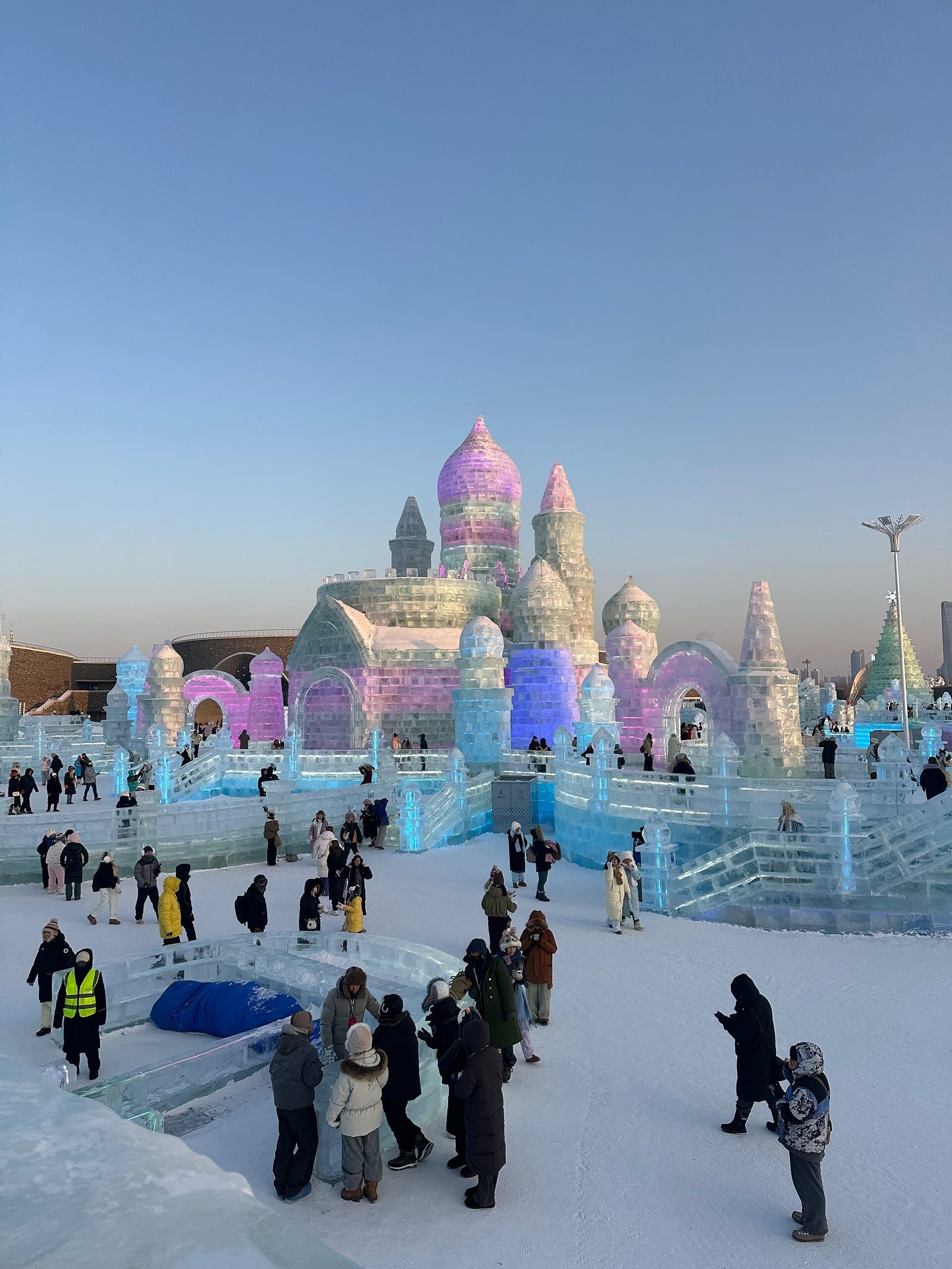
The creative use Harbiners make of ice and snow is a long-running serial. In 1963, the Zhaolin Park Ice Lantern Fair pioneered the art of the ice lantern in China — park workers chiseled lampshades out of blocks of Songhua River ice with candles burning inside, and the city's first ice-lantern exhibition, held on a bitter winter night, caused a sensation. In 1999, to greet the millennium, the Harbin Ice and Snow World was born — an entire “city of ice and snow” built from Songhua River ice: ice buildings scaled down from real architecture, inlaid with colored lights, and once night falls and they switch on, a crystal fairyland of a city.
Today the project is the world's largest ice-and-snow theme park: in the 2025–2026 season, its 27th edition expanded to 1.2 million square meters (the largest ever), consumed hundreds of thousands of cubic meters of ice and snow, and drew millions of visitors within a single edition. Around it have grown winter swimming in the Songhua River, ice boats, spinning ice tops (choubinga), and free ice slides in every corner of the city — in Harbin, ice and snow are not scenery; they are a public way of life.
The “Erbin phenomenon” of the winter of 2024–2025 deserves a line of its own: southern tourists headed north on a massive scale, and with an unprecedented guest-pampering playbook (frozen pears elegantly plated, an artificial moon, parades of the Oroqen people), Harbin turned into a top-of-the-charts sensation and set records for single-season visitor numbers; in February 2025, the 9th Asian Winter Games were held in Harbin as well — the city's ice-and-snow narrative has been upgraded from a natural endowment into a full-fledged industry and city brand.
Northeast Character and Everyday Harbin
The Harbin temperament is the Northeast temperament with the volume turned up: blunt, funny, instantly familiar, with a dialect that comes with built-in comic timing (“gan ha ne?” — whatcha up to; “lao bizi le” — a whole lot; “bolenggair ka maluyazishang” — kneecap met the curb). The food is Chinese-Western by birth: guobaorou (sweet-and-sour pork fritters, created in 1907 by Zheng Xingwen, chef of the Daotai prefect's yamen, who converted a savory soy-braised pork dish into a sweet-and-sour one to suit Russian guests — the birth of a single dish is a footnote to this city's East-meets-West story), red sausage and dalieba (the fruitwood-smoked aromas of Churin and Lidos), Modern (Madier) ice cream bars (made since 1906 — eating one on Central Street in the depths of winter is a beloved ritual), kvass, pickled cucumbers, iron-pot stews (tieguodun), and pig-slaughtering dishes (shazhucai). Outdoor tanghulu and ice cream in winter, beer and barbecue in summer — the city's two tenses.
The natural and the academic sides are often overlooked by tourists: the Sun Island wetlands and the Hulan River estuary are broad expanses of green at the city's edge; Harbin Institute of Technology is one of China's top schools for aerospace and engineering (the aerospace museum on campus is worth a look); and every winter, HIT's heated covered walkways and campus life in extreme cold reliably trend on social media once again.
How to Take the City In
Come in winter and let ice and snow set the tempo: spend the day walking Central Street (Zhongyang Dajie) (buy an ice cream bar beside the Modern Hotel), then feed the pigeons and watch the snow on the square of Saint Sophia Cathedral; in the afternoon, head into the Harbin Ice and Snow World and stay from daylight until the lights come on (the moment the ice buildings light up is the park's high point — and queue once for the giant ice slide); at night, close out with an iron-pot stew or a Russian dinner. The next day, walk a stretch of the frozen Songhua River, or go admire the snow sculptures at the Sun Island Snow Sculpture Expo; if history is your thing, string the Orthodox cathedral, the Old Jewish Synagogue, and the Chinese Eastern Railway bridge (the railway bridge with its viral glass walkway) into a single “railway city” trail. Come in summer and it is another city entirely: the cool of the low twenties, wetlands and beer festivals, the green shade of Sun Island — that is the Harbin locals love best.
One last practical reminder: in winter, Harbin's hotels keep indoor temperatures above 24℃, while outside it is twenty to thirty below — dress in layers, protect the ends of your limbs, and stick hand warmers onto your phone. Get those three things right, and the city of ice and snow is pure pleasure.
Frequently asked questions
When is the best time to visit Harbin?
The ice-and-snow season runs from late December through February (the Harbin Ice and Snow World usually opens in mid-to-late December). If you want ice lanterns but fear the extreme cold, come before the end of December; January is the coldest month — and the month when the ice sculptures are at their most solid. Summer is pleasantly cool (around 20℃), the season for escaping the heat and exploring the wetlands.
How should I dress for winter in Harbin?
−20℃ to −30℃ is the norm: three layers — down jacket, fleece, and thermal underwear — plus snow boots, a hat, gloves, and a scarf, none of them optional. Phones drain extremely fast outdoors, so stick hand warmers on your phone to protect both phone and hands. Indoor heating is very strong, so easy-to-remove layers are the most practical approach.