
Which Apps Work in China and Which Are Blocked? The State of Google, WhatsApp, and Instagram (2026)
By PandaTrip Editorial · 3 min read · Verified 2026-09-06
Verified 2026-09-06
“Will I still be able to scroll Instagram in China?” — If you are on a mainland Chinese network, most likely not. This checklist helps you judge in advance which digital habits will be interrupted and which will not, so your alternatives are ready before you land.
Services You Cannot Access Directly
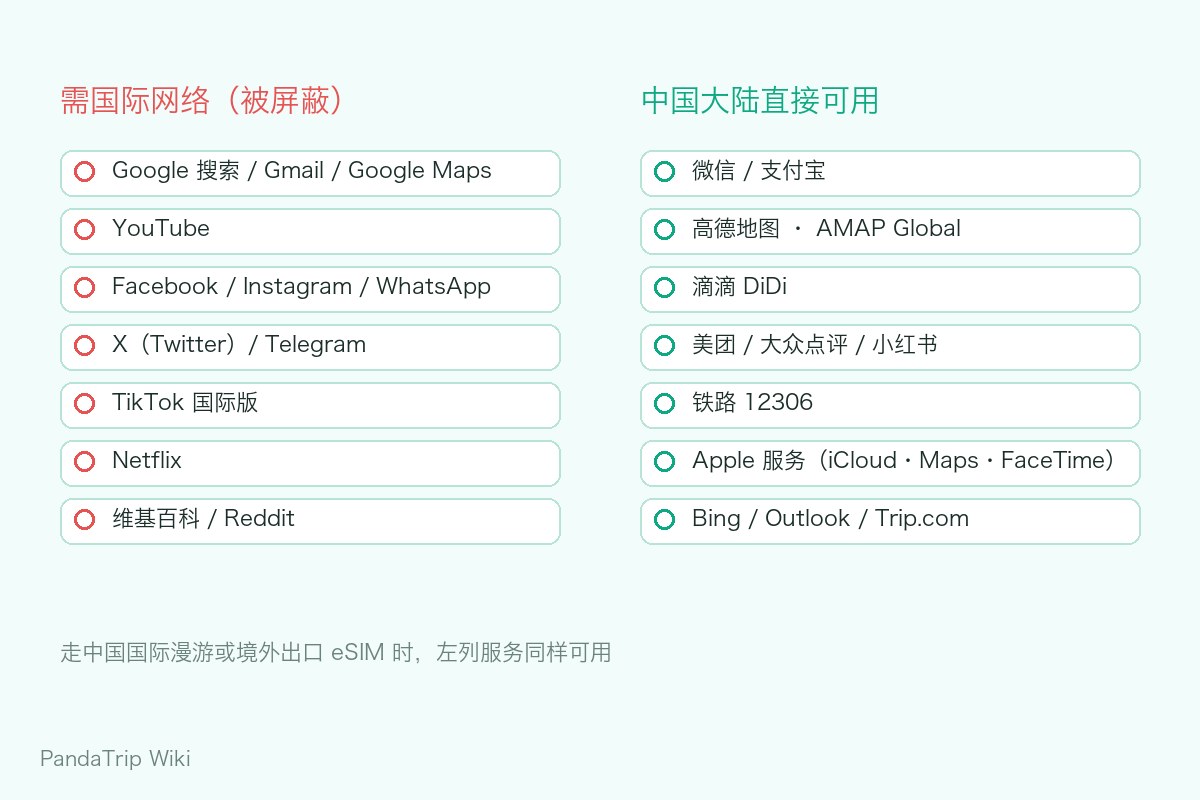
On a mainland Chinese network, the following services cannot be reached (users on international roaming or an overseas-routed eSIM are unaffected — see “Getting Online in China: How to Choose” for how this works):
| Category | Services |
|---|---|
| Google suite | Google Search, Gmail, Google Maps, YouTube, Google Drive, Google Photos |
| Meta apps | Facebook, Instagram, WhatsApp, Messenger, Threads |
| Social / community | X (Twitter), Telegram, Reddit, Discord, Twitch |
| Video streaming | Netflix, Hulu, HBO |
| Other | Wikipedia (all languages), some foreign news media, the international version of TikTok |
Two commonly misunderstood points: the international version of TikTok does not work in mainland China (ByteDance operates a separate product, “Douyin,” domestically), and Gmail is not merely unopenable as an app — the IMAP/SMTP mail protocols are equally unreachable, so receiving Gmail in a mail client depends entirely on an international network channel.
Services That Work Normally
The essentials for travel are almost all in this column:
- The full Apple ecosystem: App Store, iCloud, iMessage, FaceTime, Apple Maps, Apple Pay — Apple operates in compliance in China, and the experience is complete.
- Microsoft services: Bing (cn.bing.com), Outlook mail, Office for the web, OneDrive.
- Travel services: Trip.com, Booking.com, Agoda, Klook, and the apps of major airlines.
- Communication: WeChat and everything inside Alipay; international calls and SMS work normally.
- Chinese local apps: Amap/AMAP, DiDi, Meituan, Dianping, Xiaohongshu (RedNote), 12306… all normal — these are the tools actually used at high frequency in China.
- Most foreign banking apps: connections work (over their own channels), but push notifications may lag.
Three Things You Can Manage Without a VPN
The impact of losing these services is often overestimated. Local tools cover all of the following high-frequency needs:
- Email: register an Outlook or QQ Mail account as a stopgap, or set important mail to forward; company mail running on Exchange is mostly unaffected.
- Navigation: PandaTrip (built-in map wired to local data, coordinates adapted, nearby search across 25 categories), or AMAP Global or Apple Maps — all far more accurate in China than Google Maps (see “Which Maps App Should You Use in China?”).
- Translation: PandaTrip (voice conversation and phrase cards), Baidu Translate, Youdao Translate, and Apple's built-in Translate all work — Google Translate happens to be on the blocked list, so be sure to install an alternative before departure (see “Translation Apps and Language Survival Guide”).
The Day-Before-Departure Checklist
- Finish syncing photos and cloud drives — Google Photos disconnects the moment you land;
- Install PandaTrip — maps, translation, menu scanning, and a landing toolkit in one app, with offline trip packages as a fallback when the network drops;
- Install Alipay and WeChat and link your cards;
- Tell family and friends: while you are in China, WeChat is the fastest way to reach you;
- If Instagram or Gmail is a hard requirement, activate an international roaming day pass or buy an overseas-routed eSIM before departure — this is the compliant, stable option, and far calmer than improvising after you land.
As for VPNs: they sit in a legal gray zone in China. The risks of personal use and the compliant alternatives are covered in a separate article, “VPN in China: Risks and Alternatives” — read it before deciding.
Frequently asked questions
Does the iPhone work normally in China?
Yes. App Store downloads, iCloud, iMessage, FaceTime, and Apple Maps all work normally (Apple's cloud services operate in China in compliance with local regulations), and Apple Maps' map data for China is accurate and works well. What is blocked is the Google ecosystem, not Apple.
Which apps should I download before arriving in China?
PandaTrip (maps and navigation, translation, menu scanning, and a landing toolkit in one place), Alipay, WeChat, DiDi or AMAP Global, plus backup clients for your bank and email. Downloading foreign apps from Chinese app stores is sometimes restricted, so installing everything before departure is the safest bet.