
"Travel China Without Speaking Chinese: Translation Apps & Language Survival Guide"
By PandaTrip Editorial · 4 min read · Verified 2026-09-06
Verified 2026-09-06
Language anxiety is wildly overblown. Plenty of people travel around China for two weeks without a word of Chinese and still have a great time — provided they use the right tools. This guide covers which apps to install, how to use them, and a few language techniques that don't rely on apps at all.
First, Clear the Biggest Mine: Google Translate Doesn't Work
This is the easiest first trap to fall into: Google Translate is blocked in mainland China, and many travelers only discover their favorite tool has gone dead after landing. Install the alternatives below before departure, so they work the moment you arrive.
What to Install
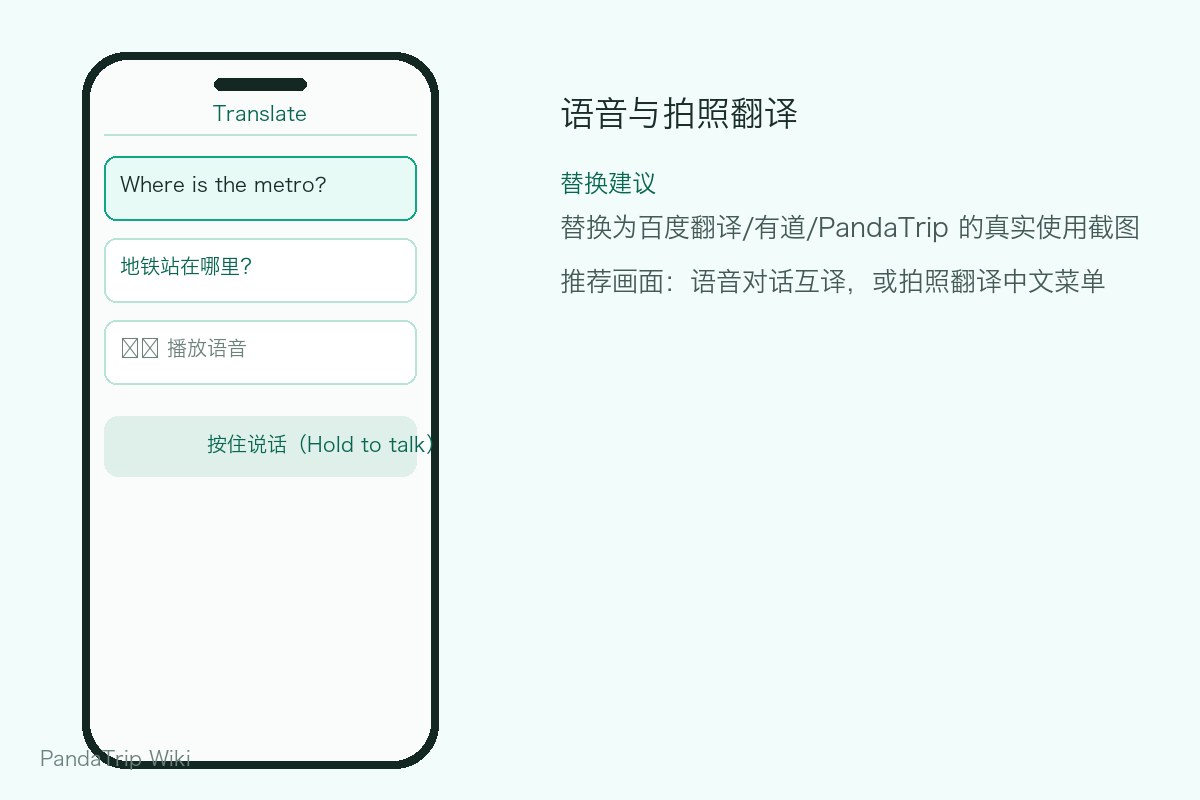
PandaTrip: A translator designed for travel in China — speak your native language and it translates into Chinese in real time and reads it aloud, or type and show a translation card. Save common sentences (“no spicy,” “go to this address”) to a personal phrasebook that can voice them even offline. Translation is wired into menu scanning and Chinese address cards, so one app covers ordering food, hailing taxis, and pharmacy runs. Translation is an AI feature and requires a pass (7 days or 1 month, one-time purchase); the interface comes in eight languages.
Baidu Translate: Photo translation is its forte — menus, street signs, information plaques: point the camera and it translates. It supports offline Chinese packs (download before departure), and the interface is available in English. Free.
Youdao Translate: Born from a dictionary, it draws finely nuanced distinctions between word senses — ideal for users who want to settle the difference between máo dù (beef tripe) and huáng hóu (aorta), two hotpot classics. Photo, voice, and offline packs are all there, and the interface can switch to English. Free.
Apple's built-in Translate (iPhone users): System-level integration. Once you go Settings → Translate → download the Chinese (Simplified) offline pack, live camera translation, Siri translation, and Messages translation work across the whole system. Deep enough that no new app is needed.
WeChat's built-in translation: Press and hold a message in a chat to translate it — a crucial feature when messaging locals on WeChat.
Recommended pairing: PandaTrip (conversation and scenarios) + Baidu Translate (photo) will carry you everywhere; for minimalists, “PandaTrip + Apple Translate” is enough. Installing five or six just means they get in each other's way.
Handling High-Frequency Scenarios
- Restaurants: Photograph the menu → read the translation and pictures → point and say “zhè ge” (this one); for spice level, just say “bú là” (not spicy);
- Taxis: Hand the driver a Chinese address card (a hotel business card works) before boarding — zero conversation required;
- Shopping: Punch numbers into a calculator — universally understood; ask prices with gestures or typing;
- Directions: Turn your screen around to show the map location, add a “zěn me zǒu” (how do I get there?) plus a pointing finger;
- Hotels/tickets: Front desks always have pen and paper; writing beats speaking.
Four Phrases to Learn (with Pinyin)
| Chinese | Pinyin | When to use |
|---|---|---|
| 你好 | nǐ hǎo | all-purpose opener |
| 谢谢 | xiè xie | all-purpose closer |
| 多少钱 | duō shao qián | shopping |
| 不要辣 | bú yào là | ordering food |
Add two more — “tài guì le” (that's too expensive) and “xǐ shǒu jiān zài nǎ” (where is the restroom) — and you're covered for essentially the whole trip.
A Fun Fact: Chinese Number Gestures
Chinese people can count from 1 to 10 on one hand: thumb and index finger bent into a hook is “9,” crossed index fingers are “10.” Street vendors may quote prices with these signs — it's perfectly normal not to read them; just hand over your phone's calculator, the universal language.
On Mindset
When Chinese people hear Chinese with a foreign accent, the first reaction is warmth, not mockery — one “xiè xie” is often answered with a carefully pronounced “Thank you.” A smile and patience when words fail are a pass that no translation app can replace. Load up the tools, then leave the rest to curiosity.
Frequently asked questions
Does Google Translate work in China?
No. Google services are blocked in mainland China, and the translation service is included. You must install alternatives before departure: PandaTrip (voice conversation and phrase cards, designed for travel in China; translation is an AI feature that requires a pass), or the zero-cost Baidu Translate, Youdao Translate (strong photo translation), and the Translate app built into the iPhone.
How good is English in China?
Hotel front desks, tourist attractions, and young service-industry staff in first-tier cities have decent basic English; taxi drivers, market vendors, and older people generally do not speak it. Numbers and place names are the global lingua franca — with a translation app and body language, you will get by just fine.